Hospital Hours: Monday-Friday: 8am-6pm | Saturday: 8am-4pm
(519) 896-0532

Before you try anything at home, make sure your cat is actually constipated. A cat straining in the litter box with nothing coming out is the same picture as a cat who can't urinate, and a blocked cat can die inside 24 to 48 hours.2 Watch for a urine puddle first. If there's urine in the box, you're likely dealing with constipation and you have a bit of time to work with.
Key Takeaways
Come in today if: your cat is straining and producing no urine, crying in the litter box, vomiting, refusing food, hiding, or flat and weak. Male cats straining with an empty box are treated as an emergency until we've felt the bladder. Call (519) 896-0532 or book online.
This is the first thing I check.
A constipated cat and a cat with a urethral obstruction look identical from across the room. Both squat. Both strain. Both go in and out of the box over and over. The difference is which end is failing, and only one can be fatal.
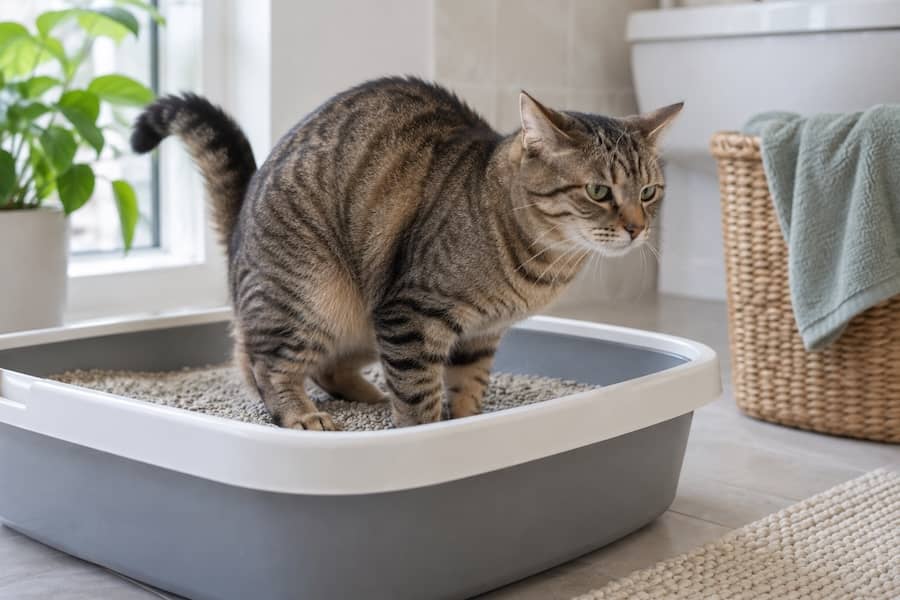
Male and neutered male cats block far more often than females because their urethra is longer and narrower.2 If you have a male cat straining with an empty litter box, treat it as an emergency and skip everything else on this page.
| What you're seeing | Points toward | What to do |
|---|---|---|
| Straining, no urine in the box, male cat | Urethral obstruction | Emergency. Go now. |
| Straining, crying out, vomiting, hiding | Obstruction or severe obstipation | Emergency. Go now. |
| Small hard dry stools, still eating and drinking | Constipation | Call us. Start fibre and water in the meantime. |
| Nothing passed in 3 or more days, otherwise bright | Constipation or early obstipation | Book an exam this week. |
| Repeat episodes every few weeks, stool like pebbles | Chronic constipation, possible megacolon | Book. This one needs a long term plan. |
Most cats pass a stool at least once a day. Some healthy cats stretch it to every other day and stay perfectly comfortable.
Two days without a stool is when I'd want to hear from you. Three days is when I want to see the cat. Past that, the stool keeps drying out in the colon, which makes it harder to pass, which keeps it in there longer. That loop is how a constipated cat becomes an obstipated one, meaning the mass can no longer be evacuated at all.1
The other reason not to wait is that retained feces stretch the colon wall. Enough of that, often enough, and the muscle stops recovering. That's megacolon, and it's a much bigger problem to manage than a one-off blockage of the bowel.
If your cat is bright, eating, urinating normally and just hasn't passed a stool in a day or two, here's what's worth doing while you wait for an appointment.
| What to try | How much | Notes |
|---|---|---|
| Psyllium husk (Metamucil, unflavoured) | 1 to 4 tsp per meal, mixed into food1 | Start at the low end. Needs to go into wet food, not dry. |
| Plain canned pumpkin | 1 to 4 tbsp per meal1 | Plain pumpkin only, never pie filling. Less potent than psyllium. |
| Wheat bran | 1 to 2 tbsp per meal1 | Same idea as psyllium, usually less palatable to cats. |
| Switch to canned food | Replace some or all of the dry | The most useful change most owners can make. Canned food runs about 75% water. |
| Add a water fountain | One per floor of the house | Cats drink more from moving water. Cheap, and it works. |
Fibre only helps a cat who is drinking. Adding bulk to a dehydrated cat gives you a bigger, drier mass, which is the opposite of the goal. If your cat isn't eating or drinking well, skip the fibre and call us instead.
Anything that slows the passage of feces through the colon can do it. In practice, a handful of causes account for most of what I see.
| Cause | Why it backs them up | What I'd check |
|---|---|---|
| Dehydration | Less water in the body means drier, harder stool. The most common cause by a distance. | Water intake, and whether they're on dry food only. |
| Chronic kidney disease | Causes ongoing dehydration, and these cats often have low potassium, which weakens the colon muscle itself. | Kidney values and electrolytes on any constipated senior. |
| Arthritis and pain | Sore hips make posturing uncomfortable, so the cat holds it. Badly underdiagnosed. | How they get in and out of the box, and whether they still jump. |
| Obesity | Heavier cats groom less, move less and posture less comfortably. | Body condition score and a realistic weight target. |
| Ingested hair | Cats who overgroom swallow a lot of it, and it binds with stool in the colon. | Whether you're also seeing hairballs, and what's driving the grooming. |
| Old pelvic fracture | A pelvis that healed narrow leaves less room for stool to pass. Shows up years after a car accident. | X-ray. This one is obvious once you look. |
| Megacolon | The colon has stretched and lost its ability to contract. Sometimes follows repeated constipation, sometimes idiopathic. | X-ray, and how many episodes there have been. |
| Hyperthyroidism, diabetes | Both affect hydration and colonic function. | Thyroid level and glucose on any older cat. |
| The litter box itself | A box that's dirty, too small, in a noisy spot or up a flight of stairs will make a cat hold it. | Number of boxes, where they are, and how often they're scooped. |
The litter box is the easiest thing on that list to fix. One box per cat plus one, scooped daily, on the floor the cat actually lives on.
The first job is deciding how backed up the cat is, which usually means an x-ray and a set of bloodwork.
Mild cases often resolve with fluids under the skin and a fibre plan, and the cat goes home the same day. Cats with a colon full of hard, dry stool need that removed, and we do it under sedation or general anaesthetic with warm water enemas and manual extraction. Merck lists warm tap water or saline at 5 to 10 mL/kg as the standard, sometimes with a lubricating gel.1
Enemas go in slowly. Rushing one causes vomiting, and in a fragile colon it risks perforation.
Cats with metabolic changes on their bloodwork, or ones who've been off food for days, get admitted for intravenous fluids before anyone touches the colon. Working on a dehydrated cat turns a manageable problem into a bad one.
These are the drugs I reach for once the colon is empty and we're trying to keep it that way.
| Drug | Type | How it works | Notes |
|---|---|---|---|
| Lactulose | Osmotic laxative | Pulls water into the colon to soften stool | Safe long-term. Dose titrated to stool consistency, roughly 0.5 mL/kg every 8 to 12 hours.1 |
| Polyethylene glycol 3350 (Miralax) | Osmotic laxative | Same mechanism, tasteless powder | About ¼ tsp per cat every 12 hours, adjusted to response.1 Easier to hide in food than lactulose. |
| Docusate sodium | Emollient laxative | Helps stool retain water | 50 mg capsule every 24 hours in cats.1 |
| Cisapride | Prokinetic | Stimulates whatever colonic motility is left | 0.1 to 1 mg/kg every 8 to 12 hours.1 Compounding pharmacy only since it left the human market in 2000. |
| Mineral oil / petrolatum | Lubricant laxative | Eases passage | Short-term only. Rectal use in clinic. Interferes with nutrient absorption long-term. |
Cisapride is the prokinetic that actually works in cats, but no drug company has ever pursued veterinary approval, so it comes from a compounding pharmacy rather than off a shelf. That's routine. It does mean you can't pick it up at a human pharmacy on a Sunday, so don't let the refill run out.
You'll still see ranitidine listed as a feline prokinetic in older articles, including an earlier version of this one. I've taken it out. Ranitidine was pulled worldwide in 2020 over a contamination problem, and its motility effect in cats was only ever shown on colon tissue in a lab, not in live patients.
A cat who blocks up once will usually do it again unless something changes. Diet is where the strongest evidence sits.
A 2026 controlled trial followed 56 cats with chronic constipation across 19 European clinics for six months. Cats on a diet containing 6% psyllium failed treatment 27% of the time, against 73% on the control diet, and their stool consistency improved more at nearly every check.4 An earlier trial of 66 cats on a psyllium-enriched dry diet found the same direction of effect and good palatability.5
A psyllium-supplemented therapeutic diet does more than adding fibre to whatever they're already eating.
Beyond diet, the levers are water intake, weight and pain. Getting an overweight arthritic senior down to a healthy weight and onto pain control changes their litter box habits more than most owners expect.
Probiotics are an open question. One pilot study gave a multi-strain probiotic to 10 cats with chronic constipation and megacolon that hadn't responded to medical management, and reported clinical improvement plus reduced inflammation on biopsy.6 Ten cats is a small study, so I'd call it promising rather than proven. It's reasonable as an add-on, not as your main plan.
Some cats reach a point where the colon doesn't work anymore.
When a cat has true megacolon and keeps obstipating despite diet, laxatives and cisapride, the treatment is a subtotal colectomy, which removes most of the colon. It sounds drastic and cats generally do very well afterward. The usual trade-off is soft stool or mild diarrhea, which often improves over the following months.1,7
For cats constipated by an old narrowed pelvis, Merck recommends surgery if signs persist beyond about six months.1
I don't raise surgery early, and I do raise it before a cat has spent a year cycling through enemas. If you're back in the clinic every few weeks for the same problem, it's a conversation worth having.
Look for urine in the litter box. A constipated cat still passes urine normally. A blocked cat strains, goes in and out of the box repeatedly, and produces little or nothing. The straining looks identical from across the room, which is why this gets missed. Male and neutered male cats block far more often than females because their urethra is longer and narrower, and the time from complete obstruction until death can be less than 24 to 48 hours. If you have a male cat straining with a dry box, treat it as an emergency and come in.
Not without talking to your vet first. Both are osmotic laxatives, meaning they work by pulling water into the colon to soften the stool. In a cat who is already dehydrated, that makes the problem worse rather than better, and dehydration is the most common reason cats become constipated in the first place. The dose also depends on your cat's weight, kidney function and how much colon motility is left. Miralax is roughly a quarter teaspoon per cat every 12 hours and lactulose about 0.5 mL per kilogram every 8 to 12 hours, but both are titrated to stool consistency by a vet who has examined the cat.
It helps mild cases and it is safer than most things in a kitchen cupboard, but it is the weakest option on the list. Merck lists 1 to 4 tablespoons of plain canned pumpkin per meal mixed into food. Use plain pumpkin only, never pie filling, which contains sugar and spices. Psyllium husk at 1 to 4 teaspoons per meal does the same job more reliably. Whichever you pick, it only works in a cat who is drinking well. Adding bulk to a dehydrated cat gives you a bigger, drier stool.
Most cats pass a stool at least once a day, and some healthy cats stretch to every other day without any trouble. Two days with nothing is when I would want a phone call. Three days is when I would want to see the cat. Waiting longer matters because the stool keeps drying out in the colon, which makes it harder to pass and keeps it sitting there longer. That cycle is how ordinary constipation turns into obstipation, where the mass can no longer be passed at all.
No. This is the single most dangerous thing an owner can do for feline constipation. The small over-the-counter bottles sold for children are phosphate enemas, and phosphate enemas must be avoided in cats. In a study where healthy cats were given a single 60 mL paediatric dose, every cat developed abnormalities including high sodium, high phosphate and low calcium, and cats given the larger dose were affected more severely. Enemas for cats are a clinic procedure, given slowly, usually under sedation, with warm water or saline rather than phosphate.
Sources


