Hospital Hours: Monday-Friday: 8am-6pm | Saturday: 8am-4pm
(519) 896-0532

A swollen eye in a dog is usually an allergic reaction, an infection of the eyelid or the lining of the eye, or something stuck in the eye. Less often it's a tooth root abscess or an abscess behind the eye, and in a few cases the eyeball itself is the problem. Most of the common causes can be seen the same day. A few can't wait, and they're easy to spot: an eyeball that looks pushed forward, pain when your dog opens their mouth, or swelling that comes with vomiting or trouble breathing.
Key Takeaways
Come in now if the eyeball looks pushed out of the socket, your dog yelps when opening their mouth, the eye is cloudy or looks enlarged, or the swelling comes with vomiting, heavy drooling, pale gums or trouble breathing. Call us at (519) 896-0532, or use our emergency page after hours.
Work out what is swelling first, because that sorts the causes. The eyelids and the pink lining swell with surface problems. The eyeball itself, or the tissue behind it, points deeper.
| What swells | What you see | Usual causes |
|---|---|---|
| Eyelids | Puffy or thickened lids, sometimes the whole face | Allergic reaction, blepharitis, stye or chalazion3,5 |
| Conjunctiva (the pink lining) | Red, puffy tissue around the cornea, with discharge | Conjunctivitis, allergy, insect bite, foreign object6 |
| Below the inner corner of the eye | A swelling or a draining tract on the cheek | Tooth root abscess7 |
| Tissue behind the eye | Eye pushed forward, third eyelid showing, pain on opening the mouth | Orbital cellulitis, retrobulbar abscess1 |
| The eyeball | Cloudy, enlarged or out of the socket | Glaucoma, proptosis2,8 |
Allergic swelling is the cause I'd check first when a dog's face and eyes puff up quickly. Insect bites and stings, shampoos and medications are the usual triggers, along with some vaccines, foods and toxic plants.3,9
The swelling generally shows up within 20 minutes of exposure. It's most noticeable on the lips, the muzzle and around the eyes, and it can be bad enough that your dog can't open their eyes.3
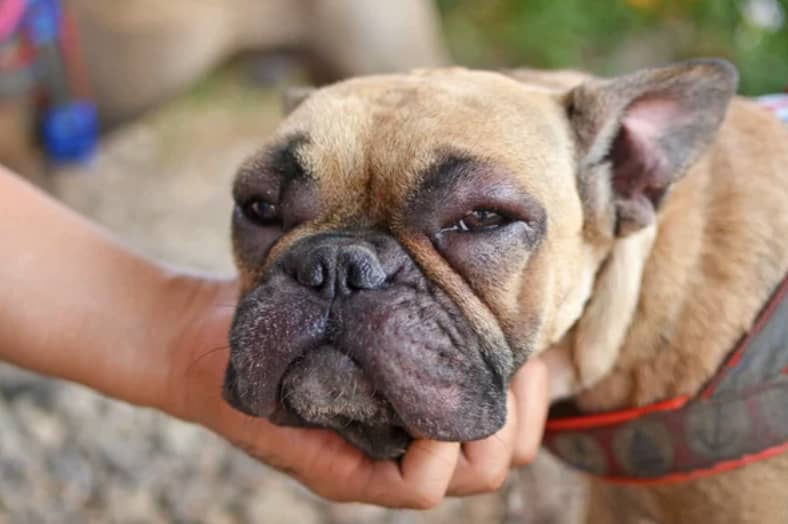
The pink lining can swell too. Insect bites and allergic reactions cause the most dramatic version, with the tissue around the cornea ballooning. Insect bites usually heal quickly with treatment.6
Hives and facial swelling are usually not life threatening, and they typically go away on their own once the trigger is removed or has passed. We treat them with antihistamines, and the weight-based doses are in our Benadryl dosing guide.3 If the swelling shows up after a vaccine or a new medication, call us right away. Vaccine reactions need a proper look.9
Anaphylaxis looks different. In dogs it shows up mainly as gut signs: sudden vomiting or diarrhea, heavy drooling, pale gums, cold limbs and collapse. It starts within seconds to minutes, and it's an emergency.3
Blepharitis is inflammation of the eyelids. It can come from skin disease that has spread to the lids, a gland infection along the lid edge, or irritants such as plant oils and sunlight.5
Demodex mites, ringworm fungi and staph bacteria are the usual culprits when infection is involved. A stye or a chalazion is a localized gland infection in the lid. Immune-mediated diseases such as pemphigus can also show up where the skin meets the lining of the eye.5
Because the causes differ, the diagnosis often takes skin scrapings, cultures or a biopsy. Treatment is often a combination of antimicrobial and anti-inflammatory medication, given systemically, plus drops or ointment. In acute cases, hot packing and frequent cleaning of the lids help.5
Something in the eye is a common reason for one swollen, watery eye. Conjunctivitis in a single eye often traces back to a foreign object, inflammation of the tear sac or dry eye.6
Corneal foreign bodies are usually organic material, such as plant matter. Sand, metal and glass turn up too.10 A migrating grass awn can also end up behind the eye, which is covered below under orbital cellulitis.1
Environmental irritants and allergens inflame the lining of the eye as well.6 If you suspect something is stuck in there, leave it for us to find and remove.
Conjunctivitis is inflammation of the conjunctiva, the pink lining of the eye, and it's common in dogs. You'd see redness, swelling of the tissue around the cornea, discharge and mild discomfort.6

The look of the eye can't tell us the cause on its own. A specific diagnosis often takes a history, an exam, a Schirmer tear test, conjunctival scrapings and occasionally a biopsy.6 One eye points toward a foreign object, tear sac inflammation or dry eye. Both eyes more often means a viral or bacterial infection, irritants or allergens.6
A discharge full of mucus or pus often gets a topical antibiotic, but the antibiotic alone may not heal the eye if something else is driving it. We also check for foreign objects, irritants, parasites and eyelid shape problems.6 If conjunctivitis keeps coming back, the underlying cause hasn't been found yet.
A dog who holds the eye shut has a painful eye, which is a different list of causes. See why dogs squint in one eye.
Orbital cellulitis is inflammation in the tissues of the eye socket, and pain when your dog opens their mouth is the clue that gives it away.1 It's common in large and hunting breeds and much less common in other breeds.11
The signs are swelling of the eyelid, a third eyelid that sticks out, a red conjunctiva and an eyeball pushed forward, usually on one side.1 A pushed-forward eye can't blink properly, so the cornea can become inflamed from exposure.1
Tooth root abscesses that erode through bone are a known cause, as are foreign bodies such as migrating grass awns and inflammation of the zygomatic salivary gland.1 A retrobulbar abscess is a pocket of pus behind the eyeball, and it pushes the eye forward in the same way.
In acute cases, antibiotics and anti-inflammatory medication are generally curative. Drainage is indicated when there's swelling behind the last molar, and warm compresses and lubricating drops protect the cornea.1 Relapses happen, so we image the teeth, sinuses and nasal cavity to find the source.1
Bleeding or a tumor behind the eye can look similar, usually without the pain on opening the mouth.1
A tooth root abscess can swell the face right under the eye, and owners often mistake it for a bite or an allergy because the swelling can appear overnight.4
The tooth involved is usually the upper fourth premolar, the large cheek tooth, or one of the molars behind it.4,7 A swelling or draining tract just below the inner corner of the eye points to it.7 An abscess at the first or second molar can swell around the eye or below and behind it, or sit mainly behind the eyeball.4
It starts with a dead tooth, most often after a fracture that exposes the pulp. A complicated crown fracture left untreated leads to a periapical abscess.4,7 Dogs often show little sign of mouth pain even when a tooth is badly infected.7
Antibiotics can settle the swelling for a while, but it returns once they stop.4 The definitive treatment is surgery, either extraction or a root canal. Antibiotics are only meant to be short term while the dog waits for it.4
Proptosis is the eyeball displaced out of the socket with the eyelids trapped behind it. It's an emergency, and it isn't swelling in the usual sense.2
Blunt trauma is the usual cause, such as being hit by a car or a fight with another dog. Flat-faced breeds are predisposed.2 The outcome depends on pupil size and reflexes, how long the eye has been exposed, other damage to the eye and socket, and any other injuries. About 25% of dogs recover vision.2
Treatment starts with lubricating the surface. The eye is then replaced under general anesthesia, the lids are temporarily sutured shut, and your dog goes on antimicrobials and corticosteroids. The sutures usually stay in for 14 to 21 days, until the swelling is gone and the blink returns.2 Don't try to push the eye back in yourself. Call us on your way so we're ready.
Glaucoma is high pressure inside the eye. An acute attack gives a painful, red, cloudy eye with a pupil that's wider than the other side.8
Pressure is typically markedly elevated, above 40 to 60 mm Hg, and vision is lost. Left long enough, the globe enlarges, which owners read as a swollen eye.8 Once vision is gone, the prognosis for getting it back is guarded, so treatment aims to lower the pressure quickly and save the vision that's left.8
A small pupil points the other way, to anterior uveitis.12 The pupil comparison and the pressure readings are covered in our guide to squinting in one eye.
There's no single treatment, because the cause sets it. The first step is a call to your vet, and the exam decides the rest.
| Cause | Usual treatment |
|---|---|
| Allergic reaction | Antihistamines, and keeping the trigger away3 |
| Blepharitis | Antimicrobial and anti-inflammatory medication, hot packing and lid cleaning5 |
| Foreign body | Finding it and removing it |
| Conjunctivitis | Treating the underlying cause, with a topical antibiotic when there's a pus or mucus discharge6 |
| Orbital cellulitis or retrobulbar abscess | Antibiotics, anti-inflammatories, drainage when needed, warm compresses and lubricating drops1 |
| Dental abscess | Extraction or root canal, with short-term antibiotics4 |
| Proptosis | Lubrication, surgical replacement under anesthesia, antimicrobials and corticosteroids2 |
| Glaucoma | Medication to lower the pressure quickly, with surgery in some cases8 |
We look at the eye and the mouth together. A swollen eye can start in a tooth, so the oral exam is part of it, and dental X-rays follow when a tooth is suspected.7
For the eye itself, a Schirmer tear test measures tear production, and a fluorescein stain shows any ulcer. A pressure reading separates glaucoma from inflammation inside the eye.6,8,12,13 When the problem sits behind the eye, imaging of the teeth, sinuses and nasal cavity finds the source.1 If the eye is held shut rather than swollen, start with our guide to squinting in one eye.
Sometimes. Treat it as an emergency if the eyeball looks pushed out of the socket, the eye is cloudy or enlarged, your dog yelps when opening their mouth, or the swelling comes with vomiting, heavy drooling, pale gums or trouble breathing. Mild puffiness of the lids with a bright, comfortable dog can usually be seen the same day. If you can't tell which one you have, call us and describe what you see.
If the swelling looks allergic, antihistamines are a common first treatment, and the dose is set by weight. Call us first if only one eye is affected, if the eye is cloudy or painful, or if your dog has any other signs, because Benadryl does nothing for infection, a tooth abscess or glaucoma. Our Benadryl dosing guide has the weight-based doses.
One swollen eye points to a local cause. A foreign object, a tear sac problem, dry eye, a tooth root abscess and an abscess behind the eye are the usual one-sided causes. Allergic swelling and irritants more often affect both eyes. One-sided swelling with pain on opening the mouth points to the eye socket or a tooth.
Yes. The roots of the upper fourth premolar and the molars sit close to the eye. An abscess at the root can swell the cheek below the inner corner of the eye, swell the tissue around the eye, or sit behind the eyeball. The swelling can appear overnight, and owners often mistake it for a bite or an allergy. Antibiotics can settle it for a while, but it returns without treating the tooth.
Allergic swelling often does once the trigger is gone, and hives usually fade within hours. Swelling from an infection, an abscess, a foreign body or pressure inside the eye doesn't, and some of those can damage the eye while you wait. Because you can't sort the two by looking, I'd have the eye seen the same day.
Hives usually fade within a few hours, and facial swelling typically goes away on its own once the trigger is removed or has passed. Either can return if your dog is exposed again. If your dog's swelling follows a vaccine or a new medication, call us rather than waiting.
Sources