Hospital Hours: Monday-Friday: 8am-6pm | Saturday: 8am-4pm
(519) 896-0532

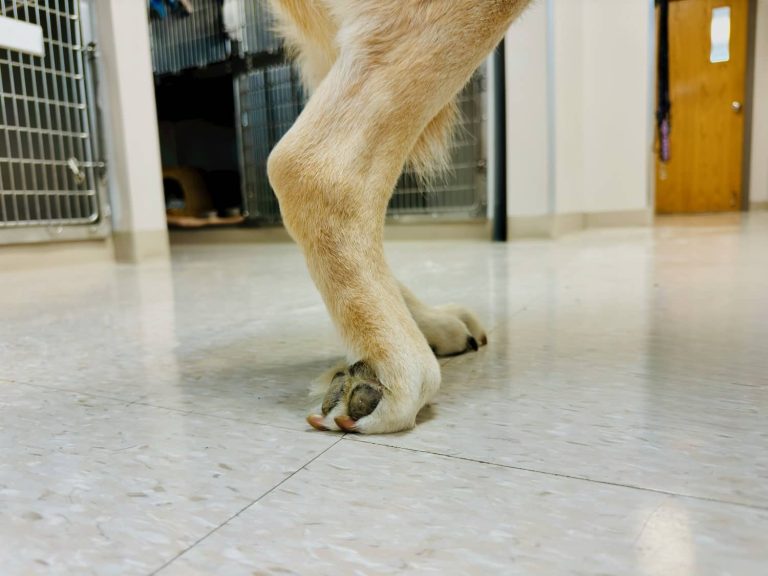
Knuckling is when a dog walks or stands on the top of the paw instead of the pad. It usually means the dog has lost track of where that paw is, which is a neurological sign called a proprioceptive deficit. Some causes come on slowly over months and some are surgical emergencies, so the speed of onset tells you a lot.
It's one of the signs I never want an owner to sit on. A dog that started knuckling this morning is a different problem from one that has been doing it since spring.
Go see your vet ASAP if you notice any of the following. Your dog started knuckling suddenly. Both hind legs are affected. They can't stand or their back end is giving out. They're crying out, tense, or won't let you touch their back or neck. They've lost control of their bladder or bowels. Sudden knuckling in the hind legs can be a disc pressing on the spinal cord, and the sooner that's decompressed, the better the odds.
Key Takeaways
The paw folds under and the dog puts weight on the top of it, on the hair and the knuckles, instead of on the pad. Sometimes it's every step. More often it's intermittent at first, and you notice it on a turn or when the dog is tired at the end of a walk.


Other things tend to travel with it. Scuffed or worn hair over the top of the paw. Nails filed flat on one side from dragging. A scraping sound on the floor that you hear before you see anything. Wobbling or swaying in the back end, which we call ataxia. Difficulty getting up off a smooth floor.
With your dog standing, gently fold one paw over so the top of it is on the floor, then let go. A dog with normal position sense flips it back immediately, almost before you've finished. A dog with a proprioceptive deficit leaves it folded, or takes a couple of seconds to notice. Do all four and see whether it's one leg, both hind legs, or everything. Your vet will want to know.
Knuckling isn't always neurological. Pain elsewhere in the limb can change how a dog loads the leg, and so can a tendon or joint problem. If your dog is also limping, our article on sudden limping in the back leg covers the orthopedic side of it. Cats get their own version of an abnormal hind paw posture, which we cover in plantigrade stance in cats.
It means your dog doesn't know where that paw is. Proprioception is the body's position sense, and it runs on a loop.
Sensors in the paw and the joint report where the limb is. That signal travels up the leg, into the spinal cord, and up to the brain. The brain works out what to do and sends instructions back down the same route to the muscles. Break the loop anywhere and the dog stops correcting the paw, because the correction depends on knowing the paw is wrong in the first place.
This is why knuckling is such a useful sign clinically. It doesn't tell you what the disease is, but it tells you the problem is in the nervous system, and where in the body the deficits show up tells us roughly where along the spinal cord to look. Hind legs only usually means the lesion sits behind the shoulders. All four legs moves our attention up into the neck.
When it comes on suddenly, when both hind legs go, or when the dog can't stand. That combination is most often a disc extrusion pressing on the spinal cord, and it's the one presentation on this page where hours genuinely count.
In a dog that can't walk, your vet checks something called deep pain perception. They apply firm pressure to a toe and watch for a conscious reaction, a turn of the head, a yelp, something that shows the signal reached the brain. A leg pulling back on its own doesn't count, because that's a reflex that happens in the spinal cord without the brain being involved.
That test is the strongest predictor of outcome we have. Across a large review of surgically managed cases, 93% of non-ambulatory dogs with deep pain perception still present recovered the ability to walk after decompressive surgery. In dogs that had lost it, 61% recovered.1 In a study of 1,501 dogs with acute thoracolumbar disc extrusion, dogs operated on the day their signs began did better than dogs operated on more than five days later, and the authors concluded surgery shouldn't be delayed unreasonably.3
Losing deep pain is not a reason to give up. There's no evidence for a hard 48-hour cut-off past which recovery becomes impossible.1 But it does turn this into a same-day conversation about referral, and that conversation goes better if you've already had it.
If your dog is dragging a back leg and straining without producing urine, that needs attention on its own. A dog that can't posture properly often can't empty the bladder either, and we cover the related problem in urinary incontinence in dogs.
Five conditions account for most of what I see. They look similar at the paw and quite different everywhere else.
| Cause | How it starts | Legs affected | Painful? | Typical dog |
|---|---|---|---|---|
| Degenerative myelopathy | Gradual, over months | Hind legs, often one worse first | No4 | Over 8 years. German Shepherd, Corgi, Boxer4 |
| Intervertebral disc disease | Sudden, hours to days | Hind legs, or all four if the neck is involved | Often, sometimes severely | Dachshund, French Bulldog, any age |
| Spinal stroke (FCE) | Peracute, under 6 hours, often during play5 | Usually one side5 | Not after the first few minutes5 | Larger breeds, middle-aged, active |
| Wobbler syndrome | Gradual, over months | All four, hind legs worse | Neck pain is common6 | Great Dane, Doberman6 |
| Carpal laxity | Over days to weeks | Front paws only | No | Large-breed puppy, roughly 6 weeks to 6 months2 |
This is the slow one. Degenerative myelopathy is a progressive breakdown of the white matter in the spinal cord, and affected dogs are usually over 8 years old when the first ataxia and hind limb weakness appear.4 It shows up most often in German Shepherds, Pembroke Welsh Corgis, Boxers, Rhodesian Ridgebacks and Chesapeake Bay Retrievers, though it turns up in other breeds too.4
It doesn't hurt. That's the detail owners find hardest to believe and the one that usually helps most, because a dog scuffing badly on the driveway is not in pain while it happens.4
There's a genetic component worth knowing about. The disease is linked to a mutation in the SOD1 gene, inherited in an autosomal recessive pattern with incomplete penetrance, and a DNA test is available through the Orthopedic Foundation for Animals.4 A dog carrying two copies is at risk. It isn't a diagnosis on its own, because plenty of at-risk dogs never develop clinical disease, but it's useful information in a breed where this sits high on the list.
Diagnosis is by exclusion. Myelography or MRI together with CSF analysis rules out the compressive and inflammatory diseases that look identical from the outside.4 Without imaging you have a suspicion rather than an answer, and the conditions being excluded are the treatable ones.
There's no drug that changes the course of it, and no evidence that steroids or supplements help.4 Physiotherapy is the intervention with the best case behind it, and it's worth doing properly rather than casually. Most dogs are euthanased for disability within one to three years of diagnosis.4 That's a hard number to read, and it's also the reason to build a mobility plan early rather than waiting for a crisis.
The discs between the vertebrae act as cushions. When one ruptures or bulges, the material presses on the spinal cord and interrupts the signals running through it. Dachshunds and French Bulldogs are the classic breeds, and obesity and repetitive stress on the back add to the risk.
Signs depend on where the disc is and how much material came out. Pain is common, and it shows up as crying out, reluctance to jump, a hunched posture, or a dog that tenses when you run a hand down its back. Then weakness in one or both hind legs, wobbling, knuckling, and in the worst cases loss of bladder control and paralysis.
Mild cases are managed with strict rest, pain relief and anti-inflammatories. Strict means crate rest, not quiet time in the living room. More severe cases need surgery to take the pressure off, and as covered above, the timing of that surgery and the deep pain perception finding shape the outcome.1,3 Physiotherapy does a lot of the work afterwards either way.
A fragment of disc material lodges in a blood vessel supplying the spinal cord and cuts off the supply to a section of it. It's a stroke, in the spinal cord rather than the brain.
The onset is the giveaway. It's peracute, meaning under six hours, and it very often happens during running, jumping or playing.5 Owners describe a dog that yelped once mid-game and then couldn't use a leg. Signs are usually markedly one-sided, with lateralisation reported in 53% to 87% of cases across studies.5
After the first 24 to 48 hours, an FCE is generally non-progressive.5 The damage is done at the moment it happens and then it stops. It isn't painful after the initial event, and the job from there is supportive care and rehabilitation while the dog recovers what it can. That doesn't mean every dog walks again, and how severe the signs are at the first examination predicts how far they'll get.
Practically that means physiotherapy, controlled exercises, hydrotherapy where it's available, and for a dog that can't move much on its own, soft bedding and repositioning every four to six hours to prevent pressure sores. Laser therapy is another option we use as part of a rehabilitation plan.
Wobbler syndrome is compression of the spinal cord in the neck, from malformed vertebrae, a bulging disc, or both. It's a disease of large and giant breeds, with Great Danes and Doberman Pinschers the two most associated.6
Because the lesion is in the neck, it affects all four legs, but the hind end almost always looks worse. Owners describe a swaying, drunken back end and a dog that's suddenly clumsy on stairs or uneven ground. Neck pain is common, and a dog that's reluctant to lift its head to take a treat is telling you something.6
If the signs are mild, I would start conservatively: activity restriction, anti-inflammatories, and physiotherapy. If the signs are severe or the dog is in a lot of pain, surgery to decompress and stabilise the neck becomes the better option. Muscle relaxants such as methocarbamol have a place alongside the rest of it.
One caution on the anti-inflammatories. Corticosteroids and NSAIDs must never be given together, and both get used in spinal disease. If your dog has leftover carprofen from an old injury, or has recently been on prednisone, say so before anything new is dispensed. Combining them risks gastrointestinal ulceration and perforation.
If you have a large-breed puppy a few months old, knuckling over at the front paws, and no other signs of illness, this is most likely carpal laxity syndrome, and the outlook is good.
It's a growth problem rather than a nerve problem. In a fast-growing puppy the flexor and extensor muscle groups around the carpus develop at slightly different rates, and for a few weeks the balance tips. The wrist buckles forward and the puppy ends up walking over the front of the paw. It typically shows up somewhere between six weeks and six months, and it's a front-limb problem, which is one of the quickest ways to tell it apart from everything else on this page.
Diet and footing both feed into it. Overfeeding, and in particular excess calcium in a growing large-breed puppy, is associated with it, as is being raised on slippery flooring with nothing to grip.
The treatment is unglamorous and it works. In a series of 47 puppies with 75 affected joints, every dog responded to conservative management, regained full extension of the joint and was walking normally at the final visit. Mean time to resolution was 2.9 weeks, with a median of two weeks and a range of one to nine.2 Bandaging shortened recovery compared with rest alone, but rest alone still got there.2
What that looks like at home: restricted, controlled exercise on surfaces with grip, no running on tile or hardwood, and a properly formulated large-breed puppy growth diet with no calcium supplementation on top of it. Your vet may add splinting or bandaging depending on how severe the buckling is.
Have it looked at rather than assuming. A puppy knuckling on the hind legs, or one that's also weak, wobbly or unwell, is not this, and that distinction is worth a consultation rather than a guess.
It starts with a neurological examination. By testing position sense, reflexes and pain response in each limb, we work out which segment of the spinal cord or which nerve is involved. That's called localising the lesion, and it determines everything that follows, including whether imaging is worth doing and where to point it.
Bloodwork comes next in most cases, partly to look for metabolic and inflammatory causes and partly because it's needed before anaesthesia.
Radiographs of the spine are useful for bony change, disc space narrowing, spondylosis and fractures. They have a real limit, though: the spinal cord itself doesn't show up on an x-ray, so a normal set of films doesn't rule out cord compression.
MRI or CT with a spinal tap gets you a definitive answer in the conditions that need one. That means referral to a veterinary neurologist and it isn't cheap, so it's worth being upfront about. I would push for it when the signs are severe or getting worse, when surgery is on the table, or when we need to exclude the treatable diseases before settling on degenerative myelopathy.4
If you're deciding whether to go ahead, the question I'd ask is what you'd do differently with the answer. When surgery is a realistic option, imaging changes the plan and is worth it. When it isn't, we can often manage supportively without it.
Treatment is aimed at the underlying cause. Alongside that, most of these dogs are living with some degree of weakness for a while, and a few practical changes make a real difference to how well they cope.
For a dog that can't get up on its own, add soft padded bedding and turn them every four to six hours to prevent pressure sores and keep the lungs clear.
Knuckling is worth acting on early, whichever cause turns out to be behind it. Get the onset speed and which legs are involved clear in your head before the appointment, because those two details do more to narrow this down than anything else you can bring us.
It depends entirely on the cause, which is why getting a diagnosis matters more than any home remedy. Knuckling from a disc extrusion often reverses well: 93% of non-ambulatory dogs that still had deep pain perception walked again after decompressive surgery, and 61% did even after losing it. A spinal stroke usually improves over weeks with rehabilitation, because the damage happens all at once and then stops. Carpal laxity in a puppy resolves almost universally with rest and a diet correction. Degenerative myelopathy is the exception, as it progresses and there is no treatment that changes its course. So the honest answer is that most causes of knuckling improve with the right treatment, and the one that does not is usually the slowest to start.
The knuckling itself is not painful, but some of the conditions behind it are. Degenerative myelopathy is not a painful disease, and a spinal stroke stops hurting after the first few minutes. Disc disease is often very painful, and wobbler syndrome frequently causes neck pain. So pain is a useful clue rather than a given. A dog that is knuckling and also crying out, tensing when touched, reluctant to jump or unwilling to lift its head is telling you something different from a dog that is scuffing happily around the garden. What does become painful over time is the paw itself, because dragging wears through the skin on top.
In a large-breed puppy between roughly six weeks and six months old, this is usually carpal laxity syndrome. The muscle groups around the wrist develop at slightly different rates during a growth spurt, the balance tips for a few weeks, and the wrist buckles forward. It is not a nerve problem and it is not painful. In a study of 47 puppies, every one recovered with conservative management, at a median of two weeks. Treatment is controlled exercise on surfaces with grip, no running on tile or hardwood, and a properly formulated large-breed puppy food with no added calcium. Have your vet confirm it though, because a puppy knuckling on the hind legs, or one that is also weak or unwell, is a different problem.
Go the same day if it came on suddenly, if both hind legs are affected, if your dog cannot stand, if they are crying out or tense when touched, or if they have lost bladder or bowel control. That picture is most often a disc pressing on the spinal cord, and the evidence supports operating without unreasonable delay. If the knuckling has been creeping in gradually over weeks or months, it still needs an appointment, but it does not need to be tonight. Either way, note when you first saw it and which legs are involved. Those two details narrow the list faster than anything else.
Usually, but not always. Knuckling is most often a proprioceptive deficit, meaning the dog has lost track of where the paw is, and that points to the nervous system. Orthopedic pain can change how a dog loads a limb and produce something that looks similar, and carpal laxity in puppies is a growth and muscle problem rather than a nerve problem. The way to tell is the paw-flip test combined with what else is going on. Fold the paw over so the top is on the floor and let go. A dog that flips it back immediately has intact position sense and probably an orthopedic issue. A dog that leaves it folded has a neurological deficit.
It is slow, which is part of what distinguishes it. Signs typically begin after eight years of age as mild wobbling and scuffing in the hind legs, often noticeably worse on one side at first, and progress over months rather than days. Most dogs are euthanased because of disability within one to three years of diagnosis. There is no drug or supplement shown to alter that course, and physiotherapy is the intervention with the best evidence behind it. Because the progression is predictable, there is real value in planning early: ramps, flooring, a support harness and a physiotherapy programme are easier to put in place before you need them.
Not always, and the question I would ask is what you would do differently with the answer. A neurological examination localises the problem to a region of the spinal cord, and that alone often directs treatment. Radiographs show bony change but not the spinal cord itself, so normal films do not rule out compression. MRI or CT with a spinal tap is what gives a definitive answer, and it means referral to a veterinary neurologist. I would push for it when signs are severe or worsening, when surgery is a realistic option, or when we need to exclude treatable disease before settling on degenerative myelopathy. When surgery is not on the table, we can often manage supportively without imaging.
Often, yes, and the trajectory is more encouraging than most owners expect when it happens. A fibrocartilaginous embolism does its damage in the first moments and is generally non-progressive after 24 to 48 hours, so the worst you see early on is usually the worst it gets. It is not painful after the initial event. Recovery comes from rehabilitation rather than surgery: physiotherapy, controlled exercise, hydrotherapy where available, and good nursing care for a dog that cannot move much on its own. How severe the signs are at the first examination is the best predictor of how far a dog will get. Not every dog walks again, but many regain a lot of function over the following weeks.
Sources


