Hospital Hours: Monday-Friday: 8am-6pm | Saturday: 8am-4pm
(519) 896-0532

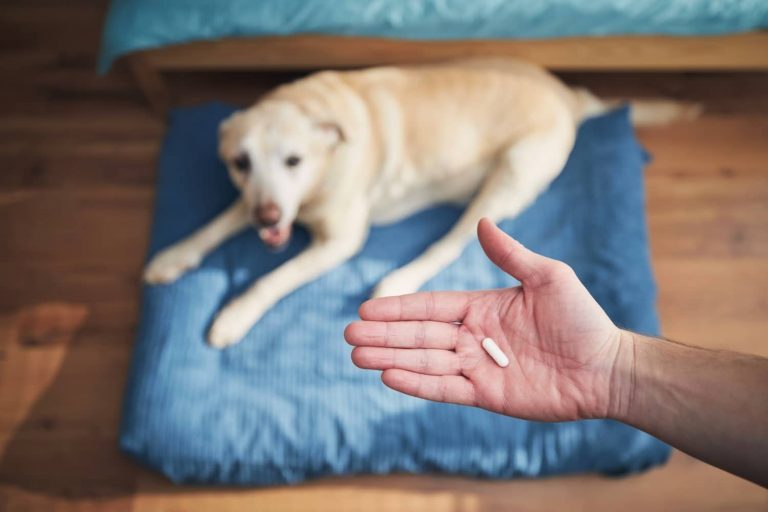
Trazodone is the drug I reach for when a dog needs to get through something. A thunderstorm, a car ride, six weeks of crate rest after a cruciate repair. The dose is 2 to 7.5 mg/kg. Whether it works depends a lot on what you're asking it to do.
Key Takeaways
Stop the trazodone and call us if you see: tremors or twitching, a stiff or agitated dog, vomiting and diarrhea together, a racing heart, a high temperature, or a dog who seems disoriented.9 These can be serotonin syndrome, and it gets worse quickly. (519) 896-0532, or our emergency page after hours.
Trazodone is a human antidepressant that veterinary medicine borrowed. It's used off-label in dogs, and it's now one of the most commonly prescribed behaviour drugs in practice.
The class name is SARI, serotonin antagonist and reuptake inhibitor. Two jobs at once. It blocks the serotonin transporter so serotonin hangs around longer in the synapse, and it blocks certain serotonin receptors directly. That second action is where the sedation comes from, and it's why trazodone calms a dog on the day you give it rather than over weeks. Drugs like fluoxetine only do the first job, which is why they take a month to help.
Absorption is good. In healthy dogs given 8 mg/kg, oral bioavailability was about 85%, and the elimination half-life was around 166 minutes.2 Under three hours, which is short enough to change how the drug should be dosed.
What it doesn't do is fix anything. Trazodone buys a dog a calmer few hours. It doesn't teach them that the crate is fine, and it doesn't replace a training plan. Our page on anxiety medications for dogs covers where it sits against the alternatives.

The published range is 2 to 7.5 mg/kg by mouth, every 8 to 24 hours as needed, with a ceiling of 19.5 mg/kg in any 24 hour period.1
That's a wide range on purpose. Response to trazodone varies more between individual dogs than almost any other drug I prescribe, so we start low and work up rather than guessing at the right number on day one.
| Dog's weight | Low end (2 mg/kg per dose) | High end (7.5 mg/kg per dose) | 24 hour ceiling |
|---|---|---|---|
| 5 kg (11 lb) | 10 mg | 38 mg | 98 mg |
| 10 kg (22 lb) | 20 mg | 75 mg | 195 mg |
| 15 kg (33 lb) | 30 mg | 113 mg | 293 mg |
| 20 kg (44 lb) | 40 mg | 150 mg | 390 mg |
| 30 kg (66 lb) | 60 mg | 225 mg | 585 mg |
| 40 kg (88 lb) | 80 mg | 300 mg | 780 mg |
| 50 kg (110 lb) | 100 mg | 375 mg | 975 mg |
Tablets come in 50, 100, 150 and 300 mg and are scored, so the dose we dispense gets rounded to something a tablet can actually deliver. That rounding is our job, not yours. Don't recalculate at home.
Give it with food. Food slows absorption slightly, which is fine, and it makes stomach upset less likely. For a planned event, 90 minutes ahead is about right.4 If you miss a dose, give it when you remember or skip it if the next one is close. Never double up, and leave at least 6 hours between doses.
Better in a hospital than at home, and the home evidence is thinner than it looks.
The number that gets quoted everywhere comes from a 2014 trial of 36 dogs recovering from orthopedic surgery. In that study, 32 of 36 owners, 89%, reported their dog improved moderately or extremely in calmness and tolerance of confinement.4 Onset was 31 to 45 minutes and the effect lasted about 4 hours. Good numbers.
The problem is that study had no control group. Every dog got trazodone, and owners rated their own dog against how it behaved before surgery.
The same research group ran the proper version three years later: randomised, placebo-controlled, owners and staff blinded. Trazodone didn't beat placebo on a single measure. Not calmness, not confinement tolerance, not leash control. Owners rated the treatment helpful in 73% of the trazodone group and 79% of the placebo group.5 A 2023 review of the evidence graded the whole body of work as weak.7
The 2016 hospitalised-dog study used a blinded observer scoring actual behaviours rather than owner questionnaires, and trazodone won there.6 For the anxious dog in our exam room, I'm confident in it.
For six weeks of crate rest at home, I'm less confident, and I'd rather say that than not. Some of what owners perceive is a dog who is simply healing and settling down anyway.
The dose in those trials may also have been part of the problem. The half-life is under 3 hours.2 A dose every 12 hours leaves most of the day uncovered. When I'm treating something that lasts all day, I dose every 8 hours, not twice daily.
Most dogs tolerate trazodone well. The common complaints are sedation that's heavier than you wanted, wobbliness, panting, drooling, and loose stool.4
A smaller group gets the opposite of what you're after. Agitation, restlessness, pacing, occasionally a dog who becomes bolder or snappier than usual. That's behavioural disinhibition, and it means this drug isn't right for that dog. Tell us if you see it rather than pushing the dose up.
Before surgery, owners often ask about bleeding. A 2023 placebo-controlled crossover study measured bleeding time, platelet function and ECG intervals in healthy dogs on 5 to 7.5 mg/kg twice daily and found no difference from placebo.8 Human medicine flags trazodone for both, so it's useful to have the canine data.
Serotonin syndrome is the one to actually worry about. It happens when there's too much serotonin in the system, and it's mostly a drug-combination problem rather than a trazodone-alone problem. Signs are tremors or twitching, agitation, a high heart rate, fever, vomiting and diarrhea together, dilated pupils, and a dog who isn't mentally right.9 Stop the drug and call. Dogs generally do well when it's caught early, with signs settling in 12 to 24 hours.9
Tell us everything your dog is on, including supplements. The interactions worth naming:
Pairing trazodone with an NSAID like carprofen after surgery is routine and was well tolerated in the trials.4

If your dog is on trazodone and it's working, keep going. Long-term daily use is well established, and it was well tolerated across a wide dose range in a series of 56 dogs treated for anxiety disorders.3
If it isn't working, don't quietly increase the dose. Two questions come first. Is the timing right, meaning 90 minutes before the trigger and every 8 hours if you need all-day coverage? And is trazodone doing a job it was never going to do alone? For daily, generalised anxiety, trazodone on its own is usually the wrong plan. It belongs on top of a daily medication and a behaviour plan.3
Before your appointment, write down what your dog does, when it starts, and how long it lasts. That's more useful to me than anything I'll see in the exam room, because the dog in front of me is rarely the dog you're describing. You can book online or call (519) 896-0532.
Owners in a clinical trial reported an effect 31 to 45 minutes after the dose, and 90% saw it somewhere between 16 and 90 minutes. Give it about 90 minutes before the event you are trying to get your dog through.
About 4 hours, based on the median duration owners reported in that same trial. The elimination half-life in healthy dogs is under 3 hours, so covering a whole day usually means dosing every 8 hours rather than twice daily.
The published range is 2 to 7.5 mg/kg by mouth every 8 to 24 hours as needed, with a ceiling of 19.5 mg/kg in any 24 hour period. Response varies a lot between individual dogs, so your vet will start low and adjust. Give it with food.
Yes, under veterinary supervision. Daily use is well established, and trazodone was well tolerated across a wide dose range in a series of 56 dogs treated long term for anxiety disorders. For daily generalised anxiety it usually works better layered onto a daily anxiety medication and a behaviour plan than it does on its own.
Expect heavy sedation and wobbliness. The bigger concern is serotonin syndrome, which is far more likely when trazodone has been combined with other serotonin drugs. Watch for tremors, agitation, fever, a racing heart, vomiting and diarrhea together, or a dog who seems disoriented. Stop the drug and call your vet.
Often, yes. It is routinely combined with NSAIDs and with daily anxiety medications like fluoxetine or clomipramine, but those combinations need a lower starting dose. Avoid combining it with MAO inhibitors such as selegiline or amitraz tick collars. Tell your vet everything your dog takes, including supplements.
Sources


