Hospital Hours: Monday-Friday: 8am-6pm | Saturday: 8am-4pm
(519) 896-0532


Does your dog seem to be breathing abnormally or taking more breaths per minute than usual? Heavy breathing in dogs can be a cause for concern, especially if your dog is breathing fast and it doesn't seem to be related to exercise or heat. This article will break down the top 7 reasons that can cause a dog to breathe heavily and fast. If you think your dog is struggling to breathe, it is important to get them checked out by your veterinarian as soon as possible.
Let's get right into it. Here are my top 7 reasons that can cause heavy breathing in dogs. If you would like more information on the dog's respiratory system, the signs of heavy breathing, and when you should be concerned, please continue reading to the end of the article!
Sometimes, heavy breathing is caused by problems in the upper airway – the nose, throat, and voice box (larynx). Conditions like laryngeal paralysis, where the nerves controlling the voice box don't work properly, can make it hard for your dog to take a full breath. You might hear a high-pitched wheezing sound (stridor) in addition to heavy, fast breathing.
Another common condition affecting the upper airway, the trachea (windpipe) specifically, is tracheal collapse. This typically affects smaller breed dogs and can cause them to breathe heavily if there is a significant narrowing or collapse of the trachea.
Diagnosing upper airway conditions can involve a few procedures and techniques. If laryngeal paralysis is suspected, we will sedate the patient so we can visualize the throat region. If tracheal collapse is suspected, X-rays or fluoroscopy are required to establish the diagnosis.
Treatment also depends on the condition that is causing the issue. There are surgical options for laryngeal paralysis, whereas we typically use a variety of medications to help with tracheal collapse.
Lower airway causes of heavy breathing in dogs involve the lungs. The airways or bronchi in the lungs have an accumulation of fluid, inflammation, or constriction, resulting in a wheezing sound and breathing heavy. Wheezes are generated due to blocked airflow and the sound typically occurs while exhaling. Dogs will often have heavy breathing along with coughing.
Examples of lower airway conditions that can cause heavy and fast breathing in dogs include asthma and chronic bronchitis. Bronchitis is an inflammation of the bronchi and can be caused by bacteria, viruses, or allergens among others. Asthma is a chronic condition associated with airway narrowing and swelling due to an allergic response.
Your vet may recommend medications to open up the airways (bronchodilators), reduce inflammation (corticosteroids), or provide extra oxygen if needed. It's important to find the underlying cause of your dog's breathing problems so they can get the right treatment.
Sometimes, heavy breathing in dogs is a sign of heart disease like congestive heart failure. With this condition, the heart has trouble pumping blood effectively, and fluid can back up into the lungs which is called pulmonary edema.
This makes it hard for your dog to take full breaths, so they end up breathing fast and shallow to try and get enough oxygen. You sometimes might also notice coughing or that your dog tires easily.
Remember above when we mention the average normal breaths per minute should be no higher than 30 when at rest? Dogs that have fluid in the lungs will often have breaths higher than 40 per minute while at rest or sleeping.
If your vet suspects a heart issue, they'll listen carefully to your dog's heart and lungs and may want to do additional tests. While heart disease can be serious, there are medications and lifestyle changes that can help manage it and improve your dog's quality of life.

To understand how disorders in the pleural space can cause heavy and fast breathing, you need to know what it is.
The pleural space is a very thin gap or space between the chest wall and the outer surface of your dog's lungs. It is somewhat of a lubricated sliding surface that allows your dog’s lungs to expand and contract smoothly when they breathe in and out.
Diseases can cause fluid (pleural effusion), air (pneumothorax), blood (hemothorax), chyle (chylothorax), or other substances to build up in this space. This puts pressure on the lungs, making it hard for them to expand fully. Your dog might take rapid, shallow breaths to compensate, which is a sign of heavy breathing.
Your vet will likely take X-rays or perform other imaging tests to diagnose the specific problem in the pleural space. Treatment focuses on removing the excess material (fluid, air, etc.) to relieve pressure on the lungs and may involve medications or further procedures depending on the underlying cause.
Pulmonary thromboembolism (PTE) is a serious condition that happens when a blood clot gets stuck in an artery in the lungs. This blocks blood flow and makes it hard for your dog to get enough oxygen. While not very common, PTE can happen in dogs with certain health problems or after major surgery.
Signs of PTE are often sudden and severe, including heavy breathing, respiratory distress, rapid breathing, pale gums, coughing, and even collapse. If you notice these symptoms, get your dog to your emergency vet immediately!
Treatment focuses on providing oxygen support and may involve medications to break down the clot or prevent new ones from forming.
Sometimes, heavy breathing in dogs is caused by abdominal distension, which means a swollen or enlarged belly. This puts pressure on the diaphragm (the muscle that helps the lungs expand), making it difficult for your dog to take full, deep breaths.
Abdominal distension can happen to dogs suddenly due to an injury or a ruptured abdominal mass, such as a splenic tumor. It may also happen gradually due to conditions like organ enlargement, liver disease, heart problems, cancer, or even severe obesity.
If you notice heavy and fast breathing in your dog, it is important to contact your vet quickly to find the cause, as this could indicate a serious problem.
Surprisingly, heavy breathing in dogs isn't always due to a problem within the respiratory system. Stress, anxiety, or pain can all make a dog breathe faster and heavier than normal.
Certain metabolic problems like anemia, kidney failure, or conditions that disrupt the body's acid-base balance can also lead to a dog breathing rapidly in an attempt to get more oxygen.
Dogs with diabetic ketoacidosis (DKA) will breathe fast and heavy as they try to reduce their acid load and take in more oxygen.
If your veterinarian suspects a non-respiratory cause for your dog's heavy breathing, they may perform blood tests or other diagnostics to pinpoint the issue and recommend appropriate treatment.
Ok, now that you have a basic understanding of what can cause heavy breathing in dogs, below is some detailed information that you may find helpful. We will discuss the signs of heavy breathing as well as when you should be concerned and see your vet.
Dogs possess a remarkably efficient respiratory system. Air enters through the nose or mouth, travels down the trachea (windpipe), and into the lungs. Within the lungs, tiny air sacs called alveoli perform a vital exchange: oxygen is absorbed into the bloodstream while carbon dioxide is released.
A dog's powerful diaphragm and ribcage muscles facilitate deep breaths, contributing to their healthy respiratory rate.
The delivery of oxygen is important for sustaining life, and both the respiratory and cardiovascular systems must function properly for this process to occur seamlessly.
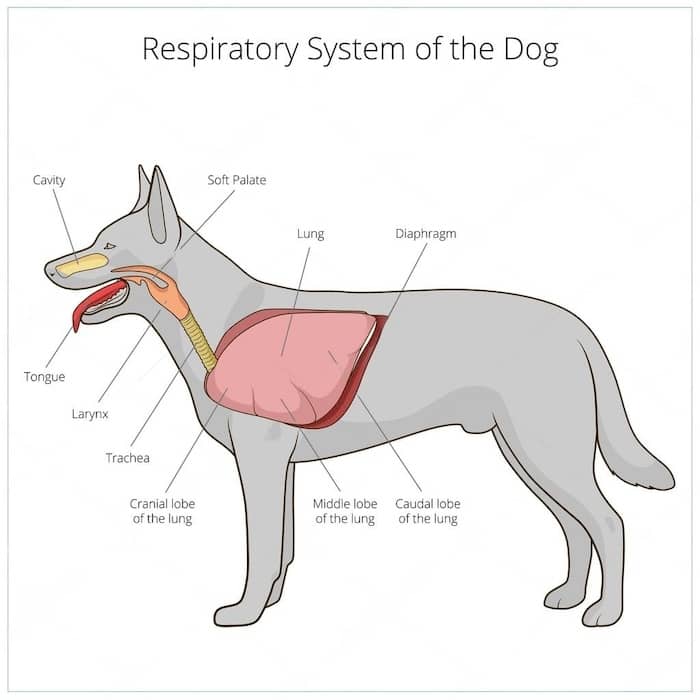
When there is a disruption in either of these systems, the consequences can be severe and breathing may be affected and progress to difficulty breathing.
Understanding normal canine respiration is helpful when trying to identify potential breathing issues.
A healthy dog at rest should breathe easily, effortlessly, and relatively quietly. Their respiratory rate (breaths per minute) varies depending on factors like breed, size, and activity level, but generally falls within the range of 10-35 breaths per minute, with an average of 24. You should see their chest rise and fall gently, but not in an exaggerated way.
Puppies usually breathe a bit faster, with a typical resting rate of 15-40 breaths per minute.
Here's what to watch for that might indicate a problem:
Always consider your dog's individual baseline. If there's a noticeable change in how they normally breathe, even if it doesn't seem severe, it's worth consulting your vet.
It's normal for dogs to breathe heavily after exercise, play, or in hot weather. However, there are times when heavy breathing can signal a problem.
The following are signs that should make you concerned about your dog’s breathing:
If you notice ANY of the above signs, please see your emergency veterinarian right away!
This often means there is an underlying systemic, respiratory or cardiovascular issue. It can be caused by too few red blood cells (severe anemia), airway blockages, severe lung disorders, congestive heart failure that can cause fluid in the lungs or not enough blood reaching the lungs for oxygenation.
If you notice that your dog has changes or difficulty breathing, you should consult your veterinarian as soon as possible.
The most common causes that would cause this is heart disease or pleural space disease. Fluid accumulation within the lungs as a result of congestive heart failure can cause heavy breathing during rest as would pleural effusion which is the accumulation of fluid in the pleural space (the area between the lungs and body wall).
If you notice heavy breathing in your dog at rest, be sure to talk to your veterinarian about this. Heavy, laboured breathing should not go unnoticed and treatment may be necessary.
Heavy breathing in dogs can be caused by upper or lower airway conditions, congestive heart failure, pleural space diseases, pulmonary thromboembolism, abdominal distension and even non-respiratory causes such as stress or metabolic acidosis. It's important to take them to your veterinarian as soon as possible if you notice heavy breathing so they can determine the underlying cause. With their expertise, they can offer advice on how best to address the problem and get your dog feeling better!


