Hospital Hours: Monday-Friday: 8am-6pm | Saturday: 8am-4pm
(519) 896-0532


Feline miliary dermatitis is a rash of small, crusty scabs that feel like grains of sand under your cat's coat. It usually sits along the lower back and the base of the tail. Here's the part most owners don't hear: miliary dermatitis isn't a diagnosis on its own. It's a pattern your cat's skin falls into when something is irritating it, and flea allergy is behind most cases. Find the trigger and the rash goes away.
Key Takeaways
Book a same-day visit if: the skin is raw, oozing or smells bad, your cat has scratched a wound open, the scabs are spreading fast across the face or neck, your cat is off food or hiding, or anyone in the house has developed a round, scaly rash. If we're closed, our friends at the emergency veterinary clinic in Kitchener can help. Otherwise book online or call (519) 896-0532.
Most owners find this by accident. You're petting your cat, and the fur over the back feels bumpy and gritty. Below is what it is, what causes it, and what I'd do about it.
Miliary dermatitis is a rash of small red bumps and crusty scabs, usually on the back, neck and tail base. The word "miliary" just means the scabs look like millet seeds. That's it. The name describes the rash, not the reason for it.
This is the part worth understanding. Your cat's skin has a limited menu of reactions to an allergy, and vets group them into four patterns: miliary dermatitis, hair loss from overgrooming, itching around the head and neck, and a set of sores called the eosinophilic granuloma complex.1,2 Different triggers, same short list of outcomes.
So the rash tells me your cat is reacting to something. It doesn't tell me what. Two cats with identical scabs can have completely different problems. That's why the exam matters more than the rash does.
The same allergies that cause this can also cause the swollen lips and mouth sores we see in cats, which is one of the other patterns on that list.
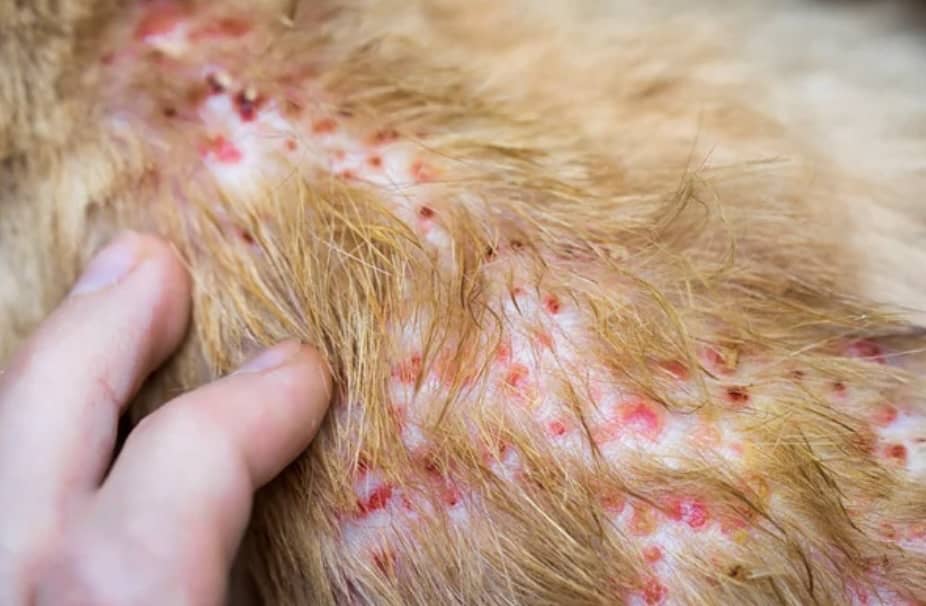
You'll usually feel it before you see it. The coat over the lower back feels rough, like sand caught under the fur.
Part the hair and you'll find small raised bumps topped with dark crusts. Some cats have a dozen. Others have hundreds running from the shoulders to the tail.
The most affected areas are the lower back, thighs, belly, head and neck.5 Fleas favour the back half. Food allergies tend to show up around the head and neck instead.
Watch for these signs alongside the rash:
Some cats hide the itch completely. If your cat grooms in private, hair loss on the belly may be the only clue you get.
Allergies cause most of it, and flea allergy leads by a wide margin. Infections and parasites make up the rest. Here's how the four main causes compare.
| Cause | Where the rash sits | Other clues | How we confirm it | First treatment |
|---|---|---|---|---|
| Flea allergy | Lower back, tail base, thighs5 | Flea dirt in the coat, though often nothing at all1 | Strict flea control, then watch the response1 | Vet flea product on every pet, plus the home1 |
| Environmental allergy | Anywhere, often face and neck2 | Starts under 5 years old, may be seasonal2 | Diagnosis of exclusion after ruling out the rest2 | Steroids, cyclosporine or allergy shots2 |
| Food allergy | Head, neck and face3 | Year-round itch, sometimes vomiting or hairballs | Strict diet trial, then a rechallenge3 | Hydrolysed or novel protein diet3 |
| Ringworm or mites | Head, ears, patchy areas4 | Scaly bald patches, other pets or people itchy too4 | Wood's lamp, skin scraping, fungal culture or PCR4 | Antifungals plus cleaning the house4 |
When I see a cat with miliary dermatitis, it's flea allergies until proven otherwise.
The reaction isn't to the flea. It's to the saliva, which carries histamine-like compounds, enzymes and proteins that the immune system learns to attack.1 That's why the whole cat itches after a handful of bites in one spot.
Cornell puts the difference plainly. Where a normal cat's skin would need dozens of bites to take real damage, an allergic cat gets the same damage from just a few.5
Owners tell me their cat never goes outside, so it can't be fleas. I'd still rule them out first. Fleas walk in on our shoes and on the dog.
And here's the frustrating part. Cats that are the most allergic are often the hardest to prove, because they groom so obsessively they can be almost completely flea-free by the time I examine them.1 No fleas on the comb doesn't clear fleas as the cause.
Pollen, mould and dust mites can all trigger this. The medical name is feline atopic skin syndrome, and miliary dermatitis is one of its most common signs.2
It usually starts in cats under 5 years old. Signs can be seasonal or run all year.2
Please bear in mind that indoor cats are not immune to outdoor, seasonal allergies. I routinely see indoor cats with seasonal allergies, and those cats then break out in miliary dermatitis. The pollen comes in on our clothes and through open windows.
There's no single test that confirms it. Environmental allergy is a diagnosis of exclusion, which means we get there by ruling out fleas, food and infection first.2 That's not us stalling. It's the only way to be sure.
If your cat has one allergy, expect more. Allergic cats rarely stop at one trigger.
Food allergy is less common than the other two, and it looks different. The itch is year-round, and it concentrates around the head and neck.3 Some cats also get frequent hairballs or vomiting.
The trigger is almost always a protein, not a grain. In cats, beef, fish and chicken are the food sources reported most often.6 Fish is worth noting, since so many cat foods are built on it.
Two things owners are usually surprised to hear.
First, blood and skin allergy tests can't diagnose a food allergy. None of them give reliably accurate results.3 If someone sells you one, you're paying for a number that won't change what we do.
Second, the diet trial is long. A review found it can take at least 10 weeks to catch 95% of food-allergic patients.3 And the diagnosis isn't confirmed until we put the old food back and the rash returns.3 That last step feels cruel, but without it you'll never know whether the diet fixed things or your cat just improved on its own.
Strict means strict. One treat, one lick of gravy, and the clock restarts. If your cat is begging constantly during a trial, call us rather than caving.
Folliculitis is an infection of the hair follicles, and it's a less frequent cause. When I suspect it, I want to rule out three things: bacterial infection, demodex mites, and ringworm.
Ringworm isn't a worm. It's a fungus, usually Microsporum canis in cats.4 It matters more than the others because it spreads to people and to your other pets.4
We check for it with a Wood's lamp, a UV light that makes infected hairs glow apple green. Between 91% and 100% of untreated infected animals will show glowing hairs.4 A fungal culture or PCR test confirms it.
I start with a full skin exam, not just the rash. Where else your cat is itchy tells me more than the scabs do.
As the most common cause is an allergy to flea bites, I always perform a thorough exam of the cat to rule out fleas as the culprit. I comb the whole coat, especially the tail base, looking for fleas and flea dirt.
From there, testing depends on what I find:
Notice that two of the five are treatment trials. That's normal in skin cases. We often confirm the cause by fixing it.
Treatment runs on two tracks at once. We settle the itch now, and we remove the cause so it doesn't come back.
For the itch, your vet may reach for:
For the cause, the work is less glamorous and more important:
One caution. Never give your cat human anti-itch or anti-inflammatory medication. Several are toxic to cats, and steroids started before a diagnosis can hide a problem we needed to see.
The itch usually settles within days of starting treatment. The scabs take two to six weeks to disappear, and the fur fills back in after that.
Fixing the cause takes longer, and the timeline depends on which cause you're dealing with:
This is where most cases go wrong. The cat looks better at week three, the flea treatment slides, and the rash is back by week eight. Finish the course.
The rash itself isn't contagious. It's an allergic reaction happening inside your cat, and you can't catch an allergy.
But two of the causes behind it do spread, so the honest answer is that it depends what's driving the rash.
Fleas spread. They'll move to your dog and to your other cats, and they'll bite people too. If one pet has fleas, every pet in the house needs treating.
Ringworm spreads to people. It's a genuine zoonotic infection, and in humans it causes skin lesions that are easily treated.4 Children and anyone with a weakened immune system are more likely to pick it up. Spores also survive in the house, so cleaning matters as much as the medication.4
If your cat has this rash and someone at home has developed a round, scaly, itchy patch, mention it when you book. It changes what we test for on day one.
Year-round flea prevention on every pet is the single best thing you can do. Lifelong flea control is what stops reinfestation, and skipping the winter months is the most common reason cats relapse.1
A few other habits help:
For cats with confirmed environmental allergies, ask about a long-term plan. There's more on how we approach this on our pet dermatology and allergy page, and a routine wellness exam is a good place to review prevention each year.
I'll examine the whole cat, comb the coat for fleas, and check the ears, chin and belly as well as the back.
I'll ask what your cat eats, including treats. I'll ask what flea product you use and exactly when you last applied it. I'll ask whether any other pet or person in the house is itchy.
Most cats go home the same day with flea treatment and something for the itch. Some need a scraping or a fungal test first. If we land on food, we'll plan the diet trial together so it's realistic for your household.
Bring a photo of the food label and the flea product box. Those two answers save a lot of guesswork.
Miliary dermatitis is common, it's treatable, and it always deserves a proper look rather than a guess. If your cat has a crusty, itchy back and you're in Kitchener, Waterloo or Cambridge, book an appointment or call us at (519) 896-0532.
Sources


