
Hospital Hours: Monday-Friday: 8am-6pm | Saturday: 8am-4pm
(519) 896-0532

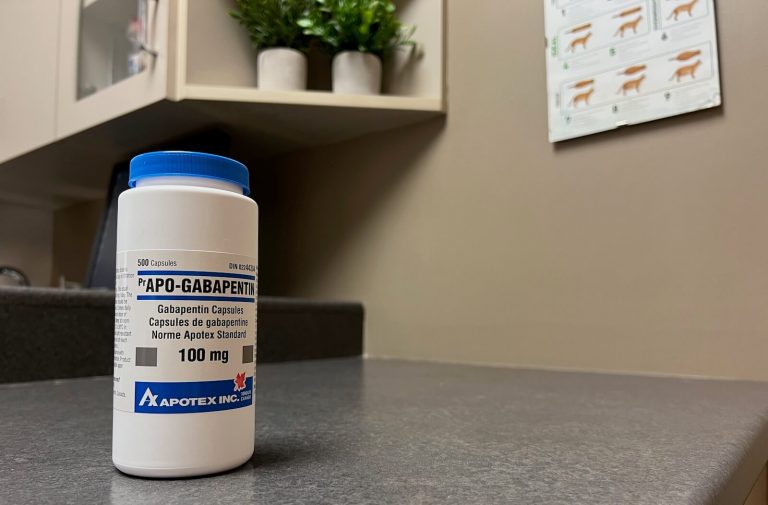
Gabapentin is the drug I reach for most often when a cat is in pain that ordinary anti-inflammatories don't cover, or when the trip to see me is the worst part of a cat's month. It works well for both. The research behind it is also more interesting than "safe and effective" suggests, and a few of the things you'll read online about it are simply wrong.
Key Takeaways
Call us if: your cat is so wobbly they can't stand, they're drooling heavily, or they've been flat for more than 12 hours after a dose. None of that is typical, and it usually means the dose needs to come down. (519) 896-0532.
Gabapentin started life as a human seizure drug. It's a structural analogue of GABA, the brain's main calming neurotransmitter, though it doesn't actually act on GABA receptors.
What it does instead is bind to the α2δ subunit of voltage-gated calcium channels on nerve endings. Less calcium moves into the nerve, so the nerve fires off fewer excitatory signals.1,2 That one mechanism covers both of the jobs I use it for. Overactive pain nerves settle down, and so does the fear response.
You'll see it described as blocking pain receptors. It doesn't, and the distinction matters. Gabapentin does nothing for inflammation, so it's no substitute for an anti-inflammatory like Onsior. The two work on separate parts of the problem, which is why I often use both.
The practical numbers: cats absorb about 90% of an oral dose, blood levels peak within 1 to 2 hours, and the half-life is roughly 3 to 4 hours.2 It leaves the body through the kidneys, unchanged.2 The kidney part matters, and I'll come back to it.
Four uses, roughly in order of how confident I am in each.

Doses vary by what you're treating, and the gap between the anxiety dose and the pain dose is wide. Confirm your cat's dose with us before changing anything.
| What you're treating | Usual dose | Timing |
|---|---|---|
| Vet visits, travel, grooming | 100 mg per cat. 150 mg for cats over about 7 kg2,3 | Single dose, 90 min to 2 h beforehand3,4 |
| Chronic or nerve pain | 5 to 10 mg/kg2 | Every 12 h, ongoing. Allow several days3 |
| Any cat with kidney disease | Roughly half the usual dose7 | Same timing. Lowest dose that works |
| Seizures | Individualised, always alongside another anticonvulsant1 | Every 8 to 12 h |
A note on the anxiety dose, because owners often find it alarming. Studies have used anywhere from 9 to 47 mg/kg for stress reduction.3 A 100 mg capsule in a 4 kg cat is 25 mg/kg, several times the pain dose. That's deliberate. You're blunting a fear response for one afternoon, not managing pain around the clock.
For stress, blood levels peak inside 2 hours and the effect tracks that closely.2,4 Give it too early and you'll have missed the window by the time you arrive.
For pain, think days. The chronic pain effect depends on the drug accumulating with repeated dosing, so I'd give it a week before deciding whether it's working.3
Duration is where the older advice online goes wrong. With a 3 to 4 hour half-life, a single dose is not covering 24 hours.1,2 The systematic review found side effects from a single dose cleared within 8 to 10 hours, which is the more realistic figure.3 It's also why the pain dose is twice daily.
Sedation and wobbliness are the two you'll actually see, and they're dose-dependent. After a pre-visit dose, a lot of cats come home and sleep it off. That's the drug working, not a problem.
The arthritis study gives the most honest picture of how common this is. Over two weeks at 10 mg/kg twice daily, 10 of 20 cats had adverse events on gabapentin: sedation, ataxia, weakness and muscle tremors. One cat had an issue on placebo.6 That's half the cats, and it's the main reason I start low and work up.
Owners in that same study still reported their cats doing better.6 I've never been sure how much of that is pain relief and how much is just a calmer cat, and I don't think the study settles it either.
Less often: drooling, vomiting, and a brief unsteadiness that looks worse than it is.3 Reassuringly, gabapentin doesn't appear to affect blood pressure, heart rate or echocardiographic measurements in healthy or hyperthyroid cats, so it's usually workable in cats already on methimazole.3
One thing to watch in older cats on long-term dosing. If your cat seems flat or is eating less, the sedation may be the cause and not the disease you're treating. A drop in appetite is always worth mentioning to us before you assume the arthritis has worsened.
This is the section I'd most want owners to read. The cats most likely to need gabapentin for arthritis are the same senior cats most likely to have chronic kidney disease.
Gabapentin leaves the body through the kidneys, unchanged.2 When kidney function drops, the drug clears more slowly and builds up.
The study that put numbers on this gave CKD cats 10 mg/kg and healthy cats 20 mg/kg. At 3 and 8 hours, 92% of the CKD cats had dose-adjusted blood levels above the healthy cats' upper range, on half the dose.7 The authors concluded that dose reduction is needed when prescribing to CKD patients.
So gabapentin is usable in kidney disease, and I use it regularly. It just needs about half the standard dose from the start, with more caution as the disease progresses. The old line about only being careful in late-stage kidney disease doesn't match the data.
Yes, with monitoring. That used to be clinical habit talking. Now there's evidence behind it.
The clearest study followed fearful shelter cats from hoarding situations on 10 mg/kg twice daily during behaviour modification. Median time to graduate the programme was halved, 9 days on gabapentin against 18 on placebo, with lower daily stress scores throughout.8
For long-term use I'd want to see your cat once or twice a year, with bloodwork that includes kidney values. Gabapentin doesn't damage the kidneys. But if kidney function slips, the dose has to come down with it.
It also combines well. In older cats I'll often run it alongside an anti-inflammatory, sometimes buprenorphine for a flare, and laser therapy where a cat tolerates it. Layering two or three modest interventions beats pushing any one of them to its limit.
Capsules can be opened and the powder mixed into a small amount of wet food. It's bitter, so a strong-smelling food helps. Use a spoonful instead of the whole bowl so you know it all went in.
If your cat won't take it that way, a compounding pharmacy can make a flavoured liquid or a smaller capsule. Usually simpler than fighting a cat twice a day.
Avoid the human liquid gabapentin from a drugstore. It's often sweetened with xylitol. Cats handle xylitol far better than dogs do, and a study giving cats up to 1,000 mg/kg found no meaningful change in blood glucose.11 The real risk is the dog in the house getting into it, which is a genuine emergency.
Missed a dose? Give it when you remember if you're within a couple of hours, otherwise skip it and carry on with the next scheduled dose. Never double up.
And if your cat has been on gabapentin daily for months, don't stop it abruptly on your own. Let us taper it, particularly if it's part of a seizure protocol.
If the problem is the vet visit itself, ask us for a pre-visit dose to try before the next appointment. One trial run at home tells you how your particular cat responds, without an appointment riding on it.
If the problem is pain, gabapentin is worth a two-week trial at the low end, though it does better as one part of a plan than on its own. Bring us anything you've noticed about jumping, litter box position, grooming or sleeping spots. Those details tell me more about feline arthritis than the exam room does.
And if your cat already has kidney disease, say so before the first dose. It changes the number.
You can book an appointment online or call us at (519) 896-0532.
For stress and fear, about 90 minutes to 2 hours. Blood levels peak inside 2 hours, and the trial that set the standard gave it 90 minutes before the cat went into the carrier. The older advice to dose 3 hours ahead usually means you have missed the best window by the time you get here. Pain is a different story. That effect builds with repeated dosing, so I would give it a week of twice daily dosing before deciding whether it is helping.
Less time than most sources online suggest. The half-life in cats is about 3 to 4 hours, and side effects from a single dose clear within 8 to 10 hours. You will see 12 to 24 hours quoted in a lot of places. That does not match the pharmacology, and it is why the pain dose is given twice daily.
The usual dose is 100 mg per cat, or 150 mg for a cat over about 7 kg, given once, 90 minutes to 2 hours beforehand. That works out to roughly 25 mg/kg in an average cat, which sounds high next to the pain dose of 5 to 10 mg/kg. It is meant to. You are blunting a fear response for one afternoon, which is a different job from managing pain around the clock. Check the number with us first, especially if your cat has kidney disease.
Yes, but the dose needs to come down by roughly half, and that applies at every stage, not only in advanced disease. Gabapentin leaves the body through the kidneys unchanged, so it builds up when kidney function drops. In one study, 92% of cats with CKD given 10 mg/kg had higher dose-adjusted blood levels than healthy cats given twice that dose. Tell us about any kidney history before the first dose.
Sedation and wobbliness, and they are dose-dependent. In a two week arthritis study at 10 mg/kg twice daily, half the cats had some adverse effect: sedation, unsteadiness, weakness or muscle tremors. Drooling and vomiting turn up less often. After a pre-visit dose most cats come home and sleep it off, which is normal. Call us if your cat cannot stand, is drooling heavily, or is still flat more than 12 hours later.
Yes. Shelter cats on 10 mg/kg twice daily during behaviour work got through their programme in half the time of cats on placebo, with lower stress scores throughout, so there is real evidence behind daily use. For long-term dosing I would want to see your cat once or twice a year with bloodwork that includes kidney values. Gabapentin does not harm the kidneys. But if kidney function slips, the dose has to come down with it.
It helps, though the picture is messier than most articles admit. In the main study, owners were about three times more likely to report improvement in their cat's problem activities on gabapentin. At the same time, collar accelerometers recorded lower daily activity on the drug than on placebo. Sedation is doing part of the work. Factor that in before you judge the result, and it is why I use gabapentin as one part of a pain plan and not the whole of it.
Not without talking to us first. The capsule strengths made for people are often far too large for a cat, and the human liquid is usually sweetened with xylitol. Cats handle xylitol much better than dogs do, so the liquid is less of a direct risk to your cat than you might read elsewhere. The real problem is the dog in the house getting into it. If your cat will not take capsules, a compounding pharmacy can make a flavoured liquid or a smaller capsule instead.
Sources


