



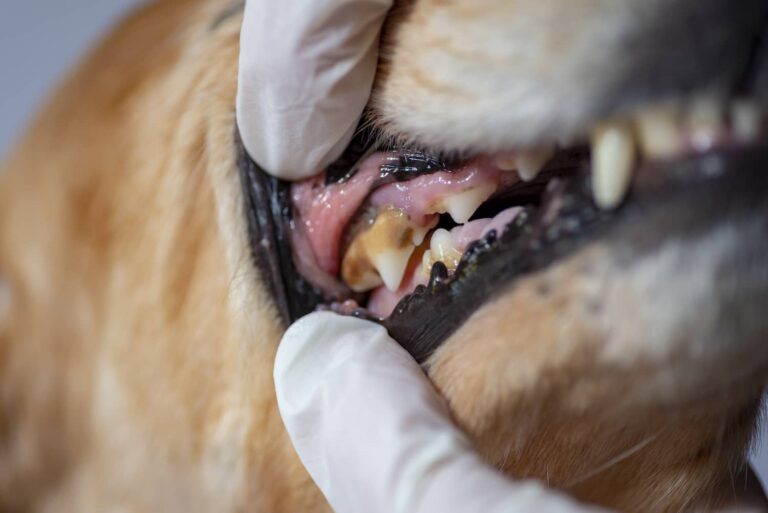
Periodontal disease in dogs is an incredibly common condition, and is often overlooked by dog owners because dogs don't show signs of oral discomfort as you would expect. In this article, I will discuss periodontal disease and its causes, symptoms and treatments.
Periodontal disease is a condition involving the teeth and the associated structures. As periodontal disease progresses, it causes significant inflammation and disease of the gums, tooth ligaments, and the bone.
There are varying degrees of severity that I will discuss later on, and each stage requires separate treatments. In the very beginning, periodontal disease in dogs starts as gingivitis, with a bright red line across the gumlines. Without treatment, this will continue to evolve into teeth with exposed roots, deep pocketing, and significant disease.
Within 24 hours, plaque, which is a sticky substance, starts to develop on the teeth. With time, this plaque continues to develop and builds up beneath the gumline. This creates an environment in which bacteria are able to proliferate and exacerbate the disease.
Within a few days, the remaining plaque will harden into calculus or tartar that is visible on the tooth's surface. This will occur above and below the gumline and requires professional scaling to remove. It is important to note that just having visible tartar accumulation doesn't mean there is severe periodontal disease. While calculus or tartar isn't harmful by itself, it allows for more inflammation and irritation, which will lead to further dental issues.
Periodontal disease is caused by plaque accumulation. It is no surprise that there are various types of bacteria present inside the mouth, and when plaque develops, it enables the bacteria to stimulate the immune system. An increase in immune system activity can occur, which results in gum inflammation.
I have found that plaque and tartar development is very individual, leading to the suspicion of genetic factors. Some older dogs that I have seen have great teeth without any dental care, whereas I can give examples of younger dogs that have multiple professional cleanings already performed in their early life.
We classify periodontal disease in dogs into 4 stages, with each stage increasing in severity.
Stage 1: Gingivitis - This is the early stage of periodontal disease, with redness and inflammation of the gums.
Stage 2: Early periodontitis - In this stage, there is some bone loss around the teeth, and the gums start to pull away from the teeth, forming pockets.
Stage 3: Moderate periodontitis - At this stage, there is significant bone loss, and the pockets around the teeth become deeper.
Stage 4: Advanced periodontitis - This is the most severe stage, where there is extensive bone loss, and teeth may be mobile or need to be extracted.
When I evaluate dogs for periodontal disease, I apply the stage for each tooth, not the whole mouth or dental arcade.
Most dogs with periodontal disease do not reveal any symptoms, and this makes it difficult to assess whether they are in pain (hint: They usually are!). Some of the potential symptoms that they may reveal include:
Please be aware that dogs are very good at hiding pain and discomfort, especially with sore teeth. We often say dogs suffer in silence when it comes to oral pain, presumably because they have no choice but to deal with the discomfort.
We diagnose periodontal disease in dogs through a variety of methods, including visual examination, tooth probing, and dental X-rays. Here are some details:
To accurately perform these tests, we need to have the pet under general anesthesia. This allows for a thorough evaluation as well as the ability to properly clean and provide any treatments (such as extractions) to your pet's teeth.
I recommend regular professional dental cleanings to help prevent periodontal disease in dogs. When done properly, these cleanings remove plaque and tartar above and below the gumline.
As it is so important to remove plaque and tartar beneath the gumline, we need general anesthesia. Dental scaling performed without anesthesia will not allow this to happen, making the whole process insignificant to the patient.
In regards to how often regular cleanings and scaling need to happen, it depends on the individual patient. On average, I find myself starting to recommend the first cleaning around 3 years of age, then every 2-3 years after that. Some dogs have cleanings done on a regular, yearly basis, while others can go longer between cleanings. This depends on genetics, home dental care and how quickly plaque and tartar develop.
In more severe cases of periodontal disease, more aggressive treatments such as extractions are often required. The criteria I have for extraction are when there are no other available treatments to regain the health and function of the particular tooth, and when the affected tooth is causing pain to the patient.
Fortunately, there are some things you can do at home to help prevent periodontal disease.
Generally speaking, when purchasing any oral care product, make sure to only use products that have the VOHC logo/label on the product. This ensures that what you are about to use is clinically proven to work. A thorough list of approved products can be found at the VOHC website.
Home dental care is broken down into two aspects. The first is mechanical action, and the second is supportive elements. Examples of mechanical actions would be tooth brushing or feeding an approved dental diet. These will mechanically remove plaque, therefore reducing tartar formation. Examples of supportive elements would be approved supplements added to the food (e.g. PlaqueOff® made by Clenz-a-Dent™) or a water additive such as Vetradent™.
Mechanical action works the best, so for dogs that do not require a specialized prescription dog food, I always recommend an approved dental food as their regular adult maintenance diet. If you combine this with regular, daily tooth brushing, you can dramatically reduce tartar formation and therefore periodontal disease.
Dental kibble is specifically designed to be abrasive yet gentle against the enamel of the teeth. Studies have shown that dogs fed a specialized dental diet have better breath and less plaque build-up compared to dogs being fed a regular kibble or canned diet.
Periodontal disease is a common condition, something that I see in dogs every day. Fortunately, it doesn't need to be difficult or time-consuming to implement daily strategies to help your dog.
If your dog already has periodontal disease, your veterinarian will recommend a Comprehensive Oral Health Assessment and Treatment (COHAT). This allows us to systematically care for all affected teeth.
If you are in the Kitchener-Waterloo area and would like us to take a look at your dog's mouth and offer suggestions, please contact us by any means!


