Hospital Hours: Monday-Friday: 8am-6pm | Saturday: 8am-4pm
(519) 896-0532

A swollen lymph node is a sign, not a diagnosis. The most useful thing you can tell me before you get here is whether it's one node or several. One enlarged node points to something local, like an infected tooth or a skin infection nearby. Several enlarged at once, in a dog who otherwise seems fine, is the pattern I take most seriously.
Key Takeaways
Some swollen nodes need to be seen today, not next week. Book a same-day appointment if the swelling appeared over a day or two, if every node you can feel is enlarged at once, if your dog is gagging or breathing noisily with large swellings under the jaw, or if there's a sudden jump in drinking and urinating. That last one can be a calcium problem that commonly occurs with lymphoma.
This is the question I ask first, and it's one you can answer at home in about a minute.
Lymph nodes are small filters spaced along the lymphatic system, which is the drainage network that clears waste and carries immune cells around the body. Each node drains a particular area, so the pattern of which ones swell tells you where the problem is.
When a node swells because of something nearby, that's called localized. When nodes swell all over the body at once, that's generalized. The two mean different things.
| What you find | What it usually means | How fast to act |
|---|---|---|
| One node, or two on the same side | Something local is draining into it. An infected tooth, a skin infection, a wound, a foreign body, or a tumour in that area | Book within a few days. Sooner if it's growing fast |
| Every node you can feel, all at once | Something is affecting the whole body. Lymphoma, an infection carried by ticks or fleas, a fungal infection, or an immune disease | Same week. Same day if your dog is also unwell |
| All nodes up, dog seems completely normal | The classic lymphoma presentation. Dogs with lymphoma more often have swelling as their only sign3 | Same week, and don't be reassured by how well they seem |
| Swelling plus fever, weight loss or lethargy | An active infection or immune disease, or lymphoma that's further along | Same day |
Feeling well is not evidence against cancer. The dogs I diagnose with lymphoma are very often bright, eating and playing normally on the day I meet them.
There are five sets you can reach with your hands. Vets call these the peripheral nodes. There are more nodes inside the chest and belly, but those need imaging to assess.
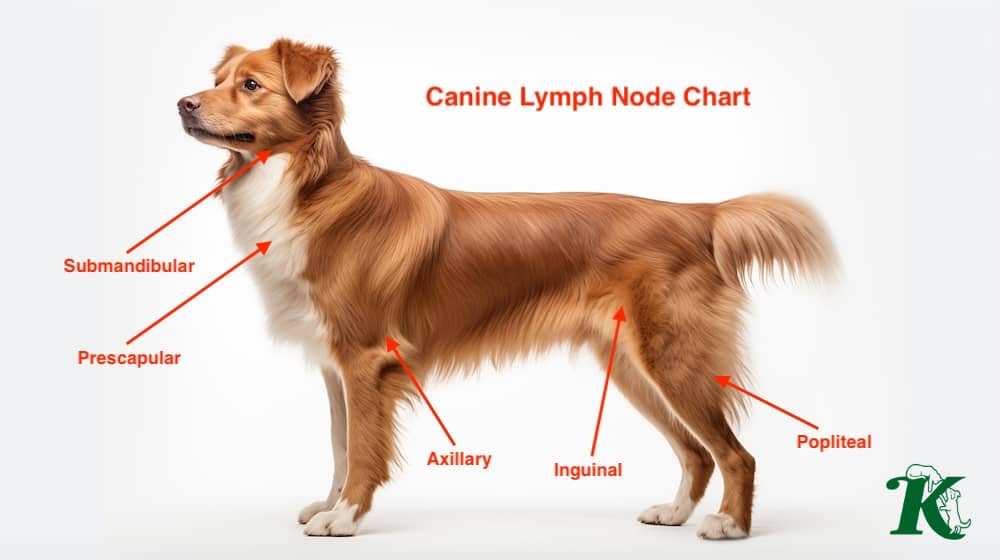
| Node | Where to feel | What drains into it |
|---|---|---|
| Submandibular | Under the jaw, just behind the back teeth, one on each side | Mouth, teeth, gums, face, ears. The set owners notice most often |
| Prescapular | In front of the shoulder blade, at the base of the neck | Head, neck and front legs |
| Axillary | Deep in the armpit. Hardest of the five to find | Chest wall and front limb |
| Inguinal | In the groin, where the back leg meets the belly | Belly wall, back end, back legs |
| Popliteal | Behind the knee, in the hollow at the back of the joint | The lower back leg and foot |
To check them at home, stand behind your dog and use flat fingers with light pressure on both sides at once. You're comparing left to right. A normal node is small enough that most owners can't find it at all, which is why finding one easily is worth a phone call.
The popliteal nodes behind the knees are the easiest place to learn what normal feels like, because they sit in a hollow with nothing else around them.
Most swollen nodes are felt, not seen. A firm, rounded lump under the skin that wasn't there last month. If the swelling is large enough to change the outline of the neck or the jawline, it's well advanced by then.
Four things I pay attention to, and you can check all four at home.
Speed matters too. A node that doubled in a week behaves differently from one that's been slightly full for six months, and I'd want to see the fast one first.
A node swells for one of two broad reasons. Either it's working hard and filling with immune cells, which is called reactive, or something has taken up residence in it.
This is the everyday cause and the one that usually ends well.
The version I see most is a single enlarged node under the jaw in a dog with dental disease. An infected tooth root drains into that node, the node responds, and it settles once the mouth is treated. If that's your dog, a dental assessment is where the answer tends to be.
Skin infections do the same thing. Deep pyoderma, an infected wound, or a bad flare of allergic skin disease will enlarge the nodes nearest to the affected skin. In that Barcelona study, skin disease was the second most common explanation at 18.4%.3
Then there are infections carried by parasites. Lyme disease, anaplasmosis and ehrlichiosis all travel by tick bite, and all three can enlarge nodes, generally with fever, lethargy or shifting lameness.6 The same study put infections carried by ticks, fleas and mosquitoes at 16.5% of cases.3 Those dogs were in Spain, where a sandfly-borne parasite is common that Canadian dogs rarely meet, so treat the exact percentages as a rough guide here.
Fungal infections belong on the list in Ontario, which surprises people. Blastomycosis and histoplasmosis both live in this province. Blastomyces favours damp, acidic soil near water, and most affected dogs live within about 400 metres of a waterway.2 Ontario laboratory surveillance over 25 years confirmed the province as an important region for both organisms.7 These infections cause coughing, weight loss and eye or skin changes alongside the swollen nodes.
Lymphoma is a cancer of the lymphocytes, the white blood cells that live in these nodes. It's the reason a dog with swollen nodes gets a same-week appointment instead of a wait-and-see.
The common form is multicentric lymphoma, which accounts for 80% to 85% of cases and shows up as painless enlargement of nodes all over the body.1 Many of these dogs feel fine at diagnosis, which is exactly why the swelling gets missed or watched for too long.
The other cancer route is spread from elsewhere. A tumour anywhere in the body can travel to the node that drains it, and that node then enlarges. This tends to be localized rather than generalized.3 Anal sac adenocarcinoma is a good example. It commonly spreads to nodes deep inside the belly, which is why a rectal exam and an ultrasound are part of the standard workup.
The exam comes first. I feel all five sets on both sides, look in the mouth, go over the skin, take a temperature and check the belly. Half the time the exam finds the cause, and it's a tooth or a patch of skin.
If it isn't obvious, the next step is a needle sample of the node itself, called a fine needle aspirate. A thin needle goes into the node, cells come out, and they go on a slide. Most dogs need no sedation and it takes under a minute. This is the test that separates infection from cancer, and it's the one worth doing early.1
Please don't give prednisone before the node is sampled. Steroids shrink swollen nodes fast, which feels like progress and makes the diagnosis harder to reach. In a study of 273 dogs with a common form of lymphoma, the dogs given steroids before diagnosis were less likely to produce a usable test result, and they had shorter remissions and shorter survival than dogs who weren't pre-treated. How much and for how long made no difference to that.5 If you have steroids at home from a previous issue, bring the bottle, don't use it.
| Test | What it answers | What to expect |
|---|---|---|
| Fine needle aspirate | Infection, or cancer, or a reactive node | Done awake in the room. Results same day if read in house, a few days if sent out |
| Blood count and chemistry | Signs of infection, organ function, and the calcium level that can travel with lymphoma | Same visit. Results usually same day |
| Urine test | Kidney function and hidden infection | Same visit, if your dog cooperates |
| Tick-borne disease test | Exposure to Lyme, anaplasma and ehrlichia | In-house blood test, minutes |
| Chest X-rays and belly ultrasound | Whether internal nodes and organs are involved, which sets the stage | Same day or booked. Ultrasound may need light sedation |
| Biopsy | Used when the needle sample is unclear or the exact subtype matters | Needs anaesthetic. Results in about a week |
| Flow cytometry or PARR | Confirms lymphoma and identifies the cell type, which changes the outlook | Sent to a lab. Usually under a week1 |
If lymphoma is confirmed, the imaging and bloodwork give us a stage from I to V, describing how far it has spread. We also add a letter: a if your dog feels well, b if there are body-wide signs like fever, weight loss or a high calcium.1 Calcium runs high in 10% to 40% of dogs with lymphoma, so it's part of the standard panel and not an add-on.1
There is no treatment for a swollen lymph node itself. You treat what caused it, and the node follows.
For a dental cause, that's a cleaning and usually an extraction. For skin infection, antibiotics and treating the allergy underneath. For a tick-borne infection, a course of doxycycline. In each of these I expect the node to be noticeably smaller within a week or two, and if it isn't, that changes the plan and we go back to sampling.
Mildly reactive nodes with an obvious cause can settle on their own. I'm comfortable rechecking rather than testing when the dog is well, the cause is clear and the node is only slightly up. What I'm not comfortable with is watching a generalized swelling in a dog who feels fine, because that's the presentation that turns out to be lymphoma.
For lymphoma, treatment is chemotherapy. Dogs handle it far better than people do, and the goal is remission with a good quality of life, not cure. Standard combination protocols get an initial response in over 90% of dogs, with median survival around 12 months for B-cell lymphoma and roughly 6 to 8 months for T-cell.1
Steroids alone are a legitimate choice if chemotherapy isn't right for your family, but the numbers are honest about what it buys. In a trial of 109 dogs treated with prednisone alone, median survival was 50 days.4 Untreated, most dogs are lost within four to six weeks of diagnosis.1
Whichever way you go, the decision belongs to you. My job is to make sure you're choosing with the real numbers in front of you instead of a guess.
Check all five sets tonight, both sides, and write down what you find. One node or several is the single most useful thing you can bring to the appointment.
If it's one node and your dog is well, book within the next few days and look in the mouth while you wait. A cracked or discoloured tooth on that side is a common answer.
If several nodes are up at once, book this week even if your dog seems perfectly normal. That combination is the one I don't wait on.
Leave the leftover steroids in the cupboard until the node has been sampled, and bring the bottle so I can see what your dog has had.
You can book online or call us at (519) 896-0532.
Usually not, which is the opposite of what most owners brace for. The nodes enlarged by lymphoma are painless, and the dog carries on eating and playing normally. A node that clearly hurts when you touch it is more likely to be infected, which is generally the better news of the two. So please don't use "it doesn't seem sore" as a reason to wait.
No. Plenty of swollen nodes turn out to be a tooth, a skin infection or a tick-borne illness, and those all get better. But cancer is common enough that it has to be ruled out rather than assumed away. Among 130 dogs referred to two Barcelona hospitals for swollen peripheral nodes, 36% were finally diagnosed with a lymphoid cancer, 18.4% had skin disease and 16.5% had an infection carried by a tick, flea or mosquito. That was a referral population, so the odds in a general practice are better than that. Even so, it's not a number I'd want to guess at.
It depends entirely on the cause, and the range is wide. A node reacting to a tooth or a skin infection resolves completely once the cause is treated. A tick-borne infection responds to a course of doxycycline. For multicentric lymphoma treated with standard combination chemotherapy, more than 90% of dogs go into remission initially, with median survival around 12 months for B-cell disease and about 6 to 8 months for T-cell. With prednisone alone, a trial of 109 dogs found median survival was 50 days. With no treatment at all, most dogs are lost within four to six weeks. That gap is why the needle sample matters so much. It tells you which of those outcomes you're dealing with.
If antibiotics are the right answer, I'd expect the node to be noticeably smaller within one to two weeks. I use that timeline as a test in itself. A node that hasn't moved after two weeks of appropriate treatment has told us the working diagnosis was wrong, and that dog needs the node sampled instead of a second course of antibiotics.
Yes, and I'd encourage it. There are five sets you can reach: under the jaw behind the back teeth, in front of each shoulder, deep in the armpit, in the groin where the back leg meets the belly, and behind each knee. Use flat fingers with light pressure, check both sides at the same time, and compare left to right. A normal node is small enough that most owners can't find it at all. The ones behind the knees are the easiest place to learn what normal feels like, because they sit in a hollow with nothing else around them.
It's about the same as a vaccination. A thin needle goes into the node, we draw off some cells, and the whole thing takes under a minute. Most dogs need no sedation and many don't react at all. Given that it's the one test that separates an infection from a cancer, it's a very small thing to put your dog through.
It matters quite a lot, and it's worth a phone call before your appointment. Steroids shrink swollen nodes quickly, which feels reassuring but makes the diagnosis harder to reach. In a study of 273 dogs with a common form of lymphoma, dogs given steroids before diagnosis were less likely to produce a usable test result, and they had shorter remissions and shorter survival than dogs who weren't pre-treated. The dose and the length of the course made no difference to that. Don't stop a prescribed medication on your own, but do tell us what your dog is on, and please don't reach for a leftover bottle to treat a lump.
If it went down within a few days, your dog is well and there was an obvious reason, such as a recent vaccination or a scrape on that leg, then a recheck at your next visit is reasonable. If it went down and then came back, or if it went down while your dog was on something like a steroid or an antibiotic, I'd still want to see it. Nodes that shrink and return are a different pattern from nodes that resolve, and that distinction is worth an exam.
Sources


