Hospital Hours: Monday-Friday: 8am-6pm | Saturday: 8am-4pm
(519) 896-0532

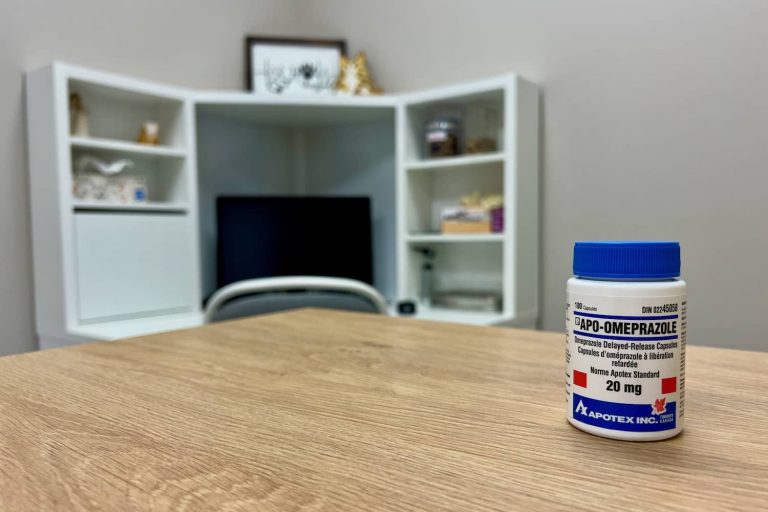
Omeprazole is a proton pump inhibitor. It switches off the pumps that make stomach acid, which is different from an antacid like Tums that neutralizes acid already sitting there. That difference explains most of what owners find confusing about this drug, including why it takes a few days to do anything.
It's a good medication and I prescribe it often. It's also prescribed more widely than the evidence supports, and the dosing advice most owners are given is out of date.
Key Takeaways
Omeprazole blocks the proton pumps in the stomach lining, and those pumps are the last step in making acid. Block them and acid production drops at the source. The active ingredient is the same one in Prilosec and Losec, and in Canada you'll most often see it as 20 mg delayed-release capsules.
The catch is that it only shuts down pumps that are switched on at the time. Pumps get activated by a meal, and the stomach doesn't turn all of them on at once, so a single dose never catches all of them. Each dose recruits a few more. That's why the effect builds over several days rather than arriving with the first capsule.
I usually tell owners to expect a response in 2 to 4 days. If your dog is still uncomfortable at 48 hours, that's the drug working normally, not the wrong drug.
The dose is 0.5 to 1 mg per kilogram of body weight, and it should usually be given every 12 hours rather than once a day.
That frequency is the part that's changed. The 2018 ACVIM consensus statement on stomach protectant drugs states that omeprazole should be given twice daily to reach the acid targets these drugs are meant to hit.1 A 2021 study gave healthy dogs 0.5 to 1 mg/kg twice daily and held the stomach pH at or above 3 for 91% of the day.2 An older study using once daily dosing, at a higher dose of 1.5 to 2.6 mg/kg, only managed 63%.4 Splitting the same daily amount into two doses does more than raising it.
There's a case report I think about with this one. A Boxer with a duodenal ulcer had been on omeprazole at 0.8 mg/kg once daily for three weeks and wasn't healing. The same dose split to every 12 hours healed the ulcer.3 Nothing changed except the schedule.
| Dog's weight | Dose range per administration | Nearest capsule size |
|---|---|---|
| 5 kg (11 lb) | 2.5 to 5 mg | Needs a compounded liquid or 10 mg strength |
| 10 kg (22 lb) | 5 to 10 mg | 10 mg capsule |
| 20 kg (44 lb) | 10 to 20 mg | 10 mg or 20 mg capsule |
| 30 kg (66 lb) | 15 to 30 mg | 20 mg capsule |
| 40 kg (88 lb) | 20 to 40 mg | 20 mg capsule |
| 50 kg (110 lb) | 25 to 50 mg | 20 mg or 40 mg capsule |
Use this to make sense of the numbers on your dog's label rather than to dose at home. Your vet picks the dose and the frequency for the condition they're treating, and some conditions get more than this.
A question I get constantly is whether a 20 mg human capsule is safe to give twice a day. For a large dog, 20 mg twice daily often lands inside the range above. For a 6 kg terrier it's several times the dose. The capsule strength is the same either way, so the answer depends entirely on the dog in front of you, and that's the part worth a phone call.
Don't crush the capsule or split a tablet to get a smaller dose. Omeprazole is destroyed by stomach acid, which is the reason it comes in a delayed-release form in the first place. Breaking the coating means most of the dose never survives the stomach, and you can't halve enteric-coated granules accurately anyway. If your dog needs less than one capsule, ask about a 10 mg strength or a compounded liquid.
The three uses with real support behind them are stomach ulcers, inflammation of the esophagus, and as part of a Helicobacter protocol.

Stomach ulcers are the clearest indication. Less acid means the ulcer gets a chance to heal and any bleeding has a chance to stop. Most ulcers I see are caused by something, usually an anti-inflammatory drug, so finding the cause matters as much as suppressing the acid.
Esophagitis and gastroesophageal reflux disease are the ones I treat most often. The esophagus has none of the stomach's defences, so acid washing back up burns it. Signs are gagging, repeated swallowing, regurgitation and sometimes a lot of drooling. Reflux also turns up alongside megaesophagus, and there the underlying problem drives the plan.
With Helicobacter, omeprazole goes in alongside antibiotics to make the stomach less hospitable to the bacteria. Plenty of healthy dogs carry Helicobacter without ever being ill from it, so a positive result on its own doesn't automatically explain why a dog is sick.
Omeprazole gets added to a lot of prescriptions where the evidence doesn't back it up, and the 2018 ACVIM consensus was written largely to push back on that.1 Four of them come up often enough in this clinic that I want to be specific, because in two the drug may be making things slightly worse rather than simply doing nothing.
The first is anti-inflammatory cover, and it's the one that changed my own practice most. It used to be routine to send omeprazole home alongside a long-term NSAID like carprofen to protect the stomach. A 2020 study tested exactly that combination in healthy dogs and found the pair raised gut inflammation markers and disrupted the gut bacteria more than carprofen on its own.5 The consensus makes the same point, that acid suppression can worsen the bacterial imbalance that contributes to intestinal injury.1 So omeprazole is for a dog who already has ulceration or bleeding, not a default add-on to an arthritis prescription. If your dog has had a genuine NSAID reaction, or has swallowed a human anti-inflammatory like ibuprofen, that's a different conversation. The combination that genuinely worries me is an NSAID and prednisone together, which should not be happening at all.
Kidney disease is the second. The old reasoning was that uremic toxins irritate the stomach lining, so acid suppression protects it. The consensus is direct that there's no evidence supporting routine gastroprotectants in dogs and cats at IRIS stages 1 to 3.1 A dog in kidney failure who is vomiting blood or has a confirmed ulcer should absolutely be on it. A dog whose bloodwork shows early kidney changes and who is otherwise eating well probably shouldn't.
Syringomyelia and hydrocephalus are the third, and this one is a genuine reversal. Omeprazole was recommended for years to reduce the production of cerebrospinal fluid, on the strength of early work where the drug was delivered directly into the fluid or given intravenously. When researchers went back and tested the oral form, they couldn't reproduce it. A 2016 study gave healthy dogs oral omeprazole for 14 days and found no measurable change in fluid production.6 A follow-up in 2019 gave a high intravenous dose and found the drug reached concentrations in the fluid below what was thought to be needed.7 I'd no longer offer it as a treatment for either condition, though you'll still find it recommended in older sources.
The fourth covers the most ground. Routine gastritis, pancreatitis and liver disease in a dog with no sign of ulceration or bleeding are all listed in the consensus as situations where acid suppression isn't indicated.1 A dog who threw up twice yesterday usually needs a diagnosis, not a proton pump inhibitor. Sometimes the better answer is a different drug entirely, like metoclopramide when the problem is motility rather than acid.
Give it 30 to 60 minutes before a meal, and give the capsule whole.
Omeprazole only blocks pumps that are actively working. Food is what switches those pumps on, so the drug needs to be absorbed and circulating by the time the meal arrives. Give it with a full stomach and you've missed the window that dose was aiming for.

The exception is a dog who vomits on an empty stomach. A few do. For those dogs I'd rather give it with a small amount of food and accept slightly less acid suppression than have the dose come straight back up.
If you miss a dose, give it when you remember unless the next one is nearly due, and never double up. Missing doses matters more with this drug than most, because the effect depends on hitting the pumps consistently. In that Boxer case report, the one day the dog's dose was missed showed up clearly in the stomach pH readings.3
Omeprazole is a safe drug at prescribed doses, and most dogs take it without any trouble at all.
The most common side effect I see is vomiting. Occasionally I'll see a patient develop diarrhea. Both are usually mild and both often settle, and moving the dose to just before a small meal fixes it in most of the dogs it affects.
The longer-term picture matters more than either of those. Stomach acid is part of how the gut controls its bacterial population, so suppressing it for months changes the balance of bacteria further down. That's the mechanism behind the NSAID finding above, and it's the main reason I don't leave dogs on omeprazole indefinitely without a reason to.5 I generally don't use it longer than three months without going back and asking what we're still treating.
Omeprazole raises the pH of the stomach, and a number of drugs need an acidic stomach to dissolve properly. Raise the pH and they're absorbed less well.
| Medication | What happens |
|---|---|
| Ketoconazole, itraconazole | Absorbed poorly at higher stomach pH, so the antifungal may underperform |
| Oral iron supplements | Absorption drops for the same reason |
| Sucralfate | Needs an acidic stomach to form its protective layer, so the two are separated by about two hours |
| Diazepam and other benzodiazepines | Cleared more slowly, so sedation can last longer than expected |
| Cyclosporine, digoxin, mycophenolate | Blood levels can shift in either direction and may need monitoring |
| Warfarin | Effect on clotting can be increased |
Antibiotics get listed as an interaction more often than they deserve. Clarithromycin is deliberately given with omeprazole in Helicobacter protocols, and the combination is intended. Ketoconazole is the one that genuinely suffers.
Give your vet the full list of what your dog is taking, supplements included, before starting omeprazole. Most of these are manageable by spacing doses apart rather than avoiding the drug.
If your dog has been on omeprazole for four weeks or longer, taper it rather than stopping on the last capsule.
Shutting down acid production for weeks makes the stomach respond by trying harder. Stop the drug suddenly and that overshoot is unopposed, so acid production rebounds above where it started and the symptoms you were treating can come back worse than before you began. The ACVIM consensus recommends dropping the dose by half each week, starting by cutting out the evening dose in the first week.1
For a short course of a week or two this doesn't apply and you can simply finish the prescription. It's the long courses that need the wind-down, and it's the step most often skipped.
Yes, and the gap is wide.
A crossover study compared both drugs in healthy dogs using continuous stomach pH monitoring. Omeprazole held the pH at or above 3 for 63% of the day. Famotidine managed 22%, against 6% for placebo.4 For any condition where acid is the problem, omeprazole is the better tool.
One note on the famotidine brand names, because it causes confusion. Famotidine is the ingredient in Pepcid AC. The Zantac sold in Canada for decades was a different drug, ranitidine, which was pulled from the market in 2020 over a contamination issue. Products now sold under the Zantac name in some countries contain famotidine instead. Check the ingredient rather than the brand.
None of which means famotidine is useless. It works faster, within hours rather than days, so it still has a place when something is needed right now. It just doesn't hold acid down the way omeprazole does over a course of treatment.
If you have questions about omeprazole for your own dog, or you're not sure whether your dog still needs to be on it, give us a call at (519) 896-0532.
Expect 2 to 4 days before you see a real difference. Omeprazole only switches off the acid pumps that are active at the time it is given, and the stomach never has all of them switched on at once, so each dose shuts down a few more than the last. The effect builds rather than arriving with the first capsule. Some dogs are more settled inside 24 hours, but a dog who is no better on day two is not a treatment failure. If there is still no change by day four or five, that is the point to go back to your vet and ask whether acid is really the problem.
Omeprazole can be given long term when there is a reason to, but I generally do not use it beyond three months without going back and asking what we are still treating. Suppressing stomach acid for months changes the balance of bacteria further down the gut, so an open-ended prescription should have a reason behind it. If your dog has been on it for four weeks or more, do not stop on the last capsule. The 2018 ACVIM consensus recommends reducing the dose by half each week, starting by dropping the evening dose, because stopping abruptly can cause acid production to rebound higher than where it started.
Often yes, but the list matters. Omeprazole raises the pH of the stomach, and several drugs need an acidic stomach to be absorbed properly. Ketoconazole, itraconazole and oral iron are the common ones that underperform. Sucralfate needs stomach acid to form its protective layer, so the two are usually separated by about two hours. Diazepam and other benzodiazepines are cleared more slowly, so sedation can run longer than expected, and cyclosporine, digoxin, mycophenolate and warfarin may need monitoring. Clarithromycin is a deliberate exception, because it is given with omeprazole on purpose in Helicobacter protocols. Give your vet the full list, supplements included, before starting.
That depends entirely on how much your dog weighs. The usual dose is 0.5 to 1 mg per kilogram of body weight, so 20 mg twice daily sits inside the normal range for a large dog of roughly 20 kg or more, and is several times the dose for a small terrier. The 20 mg capsule from a human pharmacy is the same strength either way, which is why the same question has completely different answers for two different dogs. Twice daily itself is correct and is what the current consensus recommends, so the frequency is not the part to worry about. Call your vet with your dog's weight before you settle on a number.
Yes, though vomiting is the side effect I see more often. Both are usually mild and both tend to settle on their own. Moving the dose to just before a small meal resolves it for most of the dogs it affects, even though omeprazole works slightly better on an empty stomach. Diarrhea that is severe, bloody, or lasting more than a day or two is not something to put down to the drug, and needs a look. Longer courses can also shift the balance of bacteria in the gut, which is one of the reasons I do not leave dogs on omeprazole indefinitely without a reason.
It is the same active ingredient, and vets do prescribe the human product for dogs, but it should be your vet who decides that rather than you. Two things go wrong when owners buy it themselves. The first is the dose, because a 20 mg capsule is a reasonable dose for a Labrador and a large overdose for a Chihuahua. The second is the reason for giving it at all, since a dog vomiting for an unknown reason usually needs a diagnosis rather than an acid blocker. Do not crush or split the capsule to make the dose smaller. The coating is what protects the drug from stomach acid, and breaking it means most of the dose never survives the stomach.
Sources


