Hospital Hours: Monday-Friday: 8am-6pm | Saturday: 8am-4pm
(519) 896-0532

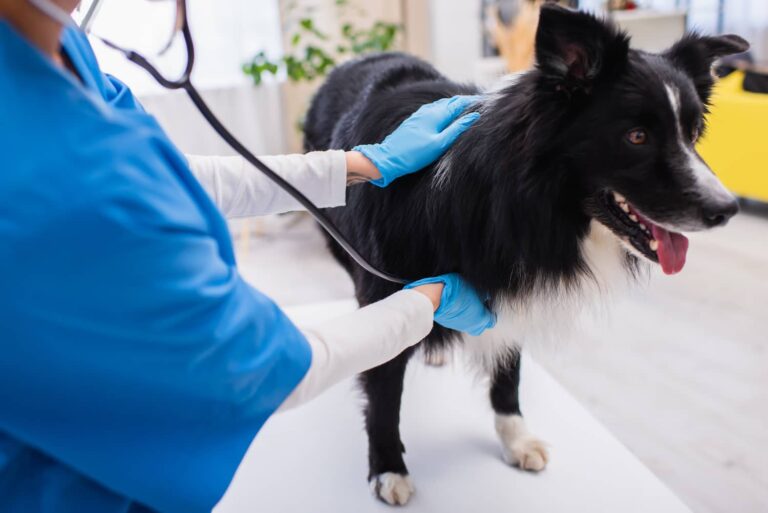
Acid reflux in dogs is stomach acid washing back up into the esophagus, and the sign you're most likely to see is regurgitation: food or fluid arriving on the floor with no heaving and no warning. Most dogs do well once we work out why the sphincter at the base of the esophagus isn't holding. The ones that get into trouble are the ones where acid has been sitting against the lining for weeks before anybody called.
Key Takeaways
Come in today if: your dog is bringing food back up and is also breathing hard, feverish or unusually flat, which points at acid reaching the lungs. Same day if he can't keep water down, if he's losing weight, or if he's started gagging and turning away from food. Call (519) 896-0532 or book online. Outside our hours, go to the nearest emergency hospital.
Acid reflux is the backward movement of stomach contents into the esophagus. The proper name is gastroesophageal reflux, and when it starts causing inflammation you'll hear it called reflux esophagitis or GERD.
Where the esophagus meets the stomach there's a ring of muscle called the lower esophageal sphincter. Its job is to stay shut. When it loosens or gets pulled out of position, acid and activated pepsin move up into a tube that has none of the stomach's defences.
How much damage it does depends on how acidic things get. Below a pH of 4 the enzyme pepsinogen converts to pepsin and starts digesting the esophageal lining itself.1 That's why we care more about how acidic it gets than about how often a dog brings food up.
Mild reflux causes nothing you'd notice.2 A dog can have a visibly inflamed esophagus and an owner who reports no problems at all.
Regurgitation is passive and vomiting is active. If you can tell me which one you saw, you've already narrowed the list of possible causes by half.
| What you're watching | Regurgitation (reflux) | Vomiting |
|---|---|---|
| Abdominal effort | None. It simply arrives. | Obvious heaving and retching |
| Warning beforehand | None, or a single swallow | Drooling, lip-licking, pacing, restlessness |
| Timing | Often soon after eating, or overnight and on waking | Any time, unrelated to position |
| What comes up | Undigested food, sometimes tube-shaped, or clear to frothy fluid | Partly digested food, often yellow or green with bile |
| Posture | Head and neck stretched out, repeated swallowing | Hunched, abdomen contracting |
| Points toward | The esophagus or the sphincter at its base | The stomach, intestines, or a whole-body problem |
Filming it on your phone is more useful than describing it. Owners are often surprised at what they see on playback, and it saves us guessing.
A dog who has regurgitated since weaning, or who does it with every meal regardless of what's in the bowl, may have megaesophagus rather than reflux. It looks the same on the floor and it's treated differently, so it's worth ruling out early.
Regurgitation is the classic sign, and the rest of the list is what an irritated esophagus does.2 Some dogs show almost none of it.
Acid reaching the back of the throat can be inhaled, and aspiration pneumonia is the complication that turns this from uncomfortable into dangerous. A dog who is regurgitating and coughing needs a chest x-ray, not a diet change.
Anything that loosens the lower esophageal sphincter, pulls it out of position, or keeps the stomach full for too long. In practice, anesthesia and flat-faced conformation account for most of what we see.
| Cause | What's actually happening |
|---|---|
| Anesthesia and sedation1,2,6 | Injectable pre-anesthetic and inhaled anesthetic drugs relax the sphincter directly. In 270 dogs monitored through routine procedures, 119 of them, or 44.1%, refluxed during the anesthetic.6 |
| Brachycephalic conformation1,3,4 | Pulling hard against an obstructed airway generates negative pressure in the chest with every breath, which drags the stomach toward the diaphragm and overcomes the sphincter.1 |
| Sliding hiatal hernia1,4,5 | Part of the stomach slides up through the diaphragm, so the sphincter sits in the chest where it can't do its job. Common in French Bulldogs.4 |
| Drugs that relax the sphincter2 | Atropine and acepromazine are the two named most often, which is part of why sedation is a risk period. |
| Chronic or repeated vomiting2 | Acid moving up over and over inflames the esophagus, and an inflamed esophagus refluxes more easily. It becomes self-sustaining. |
| High-fat meals | Fat slows the stomach from emptying, so there's more acidic content sitting against the sphincter for longer. |
| Pills that lodge in the esophagus2 | Doxycycline is the usual culprit. A capsule that stops halfway down burns the lining where it sits. Always follow a tablet with water or food. |
| Feeding tubes crossing the sphincter2 | A tube passing through the gastroesophageal junction holds it open by definition. |
| Other gut disease2 | Gastritis, pancreatitis, inflammatory bowel disease and anything causing delayed emptying all feed into it. |
| Young age | Puppies have a sphincter that hasn't finished developing, so reflux in a young dog isn't unusual and often improves with growth. |
The airway and the gut are the same problem in a brachycephalic dog. Every hard breath against a narrow airway pulls on the gastroesophageal junction, and over months that mechanical strain is enough to break the seal.1
If you own one of these breeds, the numbers are worth knowing. When 36 brachycephalic dogs were examined under fluoroscopy, 16 had a hiatal hernia, 27 had gastroesophageal reflux, and 31 had food moving down the esophagus too slowly. All 16 of the hernias were in French Bulldogs.4
In a larger study, researchers scoped 176 French Bulldogs with airway obstruction. Every dog had at least one abnormality. Inflammation at the lower esophagus was present in 79%, a hiatal hernia in 26.7%, and gastric inflammation in 77.3%.3 Median age was 24 months, so these aren't old dogs with accumulated wear.
Of the 139 dogs with esophagitis in that study, 62 weren't regurgitating, so nearly half had damage their owners couldn't see.3 If your Frenchie snores, snorts, and has never once brought up a meal, that doesn't clear him.
Fixing the airway helps the gut. In 11 French Bulldogs fitted with a wireless pH capsule, acid exposure improved in all four dogs who went on to have airway surgery.5 I'd factor that into the decision about whether to operate on the nose and throat, because it's a reason beyond the breathing.
Endoscopy is the test of choice, because it's the only one that shows you the lining directly.2 Everything else is either ruling out other causes or looking at how things move.
| Test | What it tells us |
|---|---|
| History and physical exam | Whether we're dealing with regurgitation or vomiting, and what changed. Recent anesthesia, a new medication or a diet switch often answers it. |
| Bloodwork | Rules out kidney disease, liver disease, pancreatitis and Addison's, all of which cause vomiting that can be mistaken for reflux. |
| Plain x-rays | Little or no value for seeing esophagitis itself.2 Still worth taking, because they show aspiration pneumonia and a dilated esophagus. |
| Endoscopy | Direct view of the lining, grading of the inflammation, and biopsies. It also finds a foreign body or a stricture if one is there.2 |
| Contrast study under fluoroscopy | Shows movement rather than anatomy: a sliding hernia appearing and disappearing, slow transit, reflux happening in real time.2,4 |
| Esophageal pH monitoring | Measures how long the esophagus actually spends below pH 4. Used at referral centres and in research rather than general practice.5 |
Fluoroscopy earns its place because of the sliding hiatal hernia. It comes and goes with the breathing cycle, so a still image taken at the wrong moment looks normal.
Treatment comes down to four jobs: bring the acid down, tighten the sphincter, get the stomach emptying faster, and control the pain.2 Food does some of that work and medication does the rest.
Soft food, low in fat and low in fibre, fed in small frequent meals.2 That's the whole prescription, and it does more than people expect.
Fat is the one to be strict about. It slows gastric emptying, which leaves acidic stomach contents pressed up against the sphincter for longer. Fibre slows things down too, which is why the recommendation is low in both rather than the high-fibre diet people often reach for.
Raising the bowl is often suggested, and I'd say it's reasonable to try in a dog with megaesophagus. For straightforward reflux, meal size and fat content are doing the real work.
Medications fall into three groups, and the distinctions between them get blurred constantly. An acid blocker, a coating agent and a motility drug do three different things.
| Drug | What it actually is | What to know |
|---|---|---|
| Omeprazole | Proton pump inhibitor. Shuts down the acid pump in the stomach lining. | First choice. It should be given twice daily rather than once, which is what it takes to reach the pH goals set in human medicine.1 Once-daily dosing has failed to show benefit in dogs.1 |
| Famotidine | H2 blocker. Reduces acid by a different and weaker route. | Dogs develop tolerance to it within 13 days, sometimes by day 3.1 Twice-daily famotidine on its own is inferior to a proton pump inhibitor, and there's no benefit to giving both.1 |
| Sucralfate | A coating agent, not an antacid. It binds to damaged tissue and shields it. | Give it as a slurry in water, not a whole tablet, because tablets don't break up properly in dogs.1 Separate it from other oral medications, since it interferes with their absorption.1 |
| Metoclopramide | Prokinetic. Raises sphincter tone and speeds up gastric emptying. | Useful, and the more available of the two motility drugs.2 |
| Cisapride | Prokinetic, same targets. | More potent than metoclopramide.2 It was pulled from the human market, so it comes from a compounding pharmacy now. |
| True antacids | Buffering agents like calcium carbonate. | Largely ineffective in dogs. They don't have the buffering capacity to hold pH for any useful length of time.1 |
Over-the-counter omeprazole needs one caution. The dose that suits a 4 kg dog and the dose that suits a 40 kg dog aren't the same, and the timing relative to meals changes how well it works. Get the dose from us rather than from the box.
Two outcomes worry me: a stricture and pneumonia. Both are harder to treat than the reflux that caused them.
A stricture is scar tissue narrowing the esophagus after prolonged acid exposure. It's the reason we take anesthesia seriously in these dogs: reflux during anesthesia accounts for 46% to 65% of benign esophageal strictures in dogs and is the most common cause of high-grade esophagitis and stricture formation.1 Once a stricture forms, treatment means repeated balloon dilation under anesthesia.
Aspiration pneumonia is the other one. Acid inhaled into the airway sets up inflammation and infection, and it's the reason a regurgitating dog who is also coughing or breathing hard gets moved to the front of the queue.2
Chronic ulceration in the stomach and esophagus is possible too, along with steady weight loss in dogs who have decided that eating hurts.
Reflux caught early is usually straightforward. I'd rather see a dog for a regurgitation that turns out to be nothing than see the same dog six months later for a stricture. If your dog is bringing food back up more than occasionally, or you own a flat-faced breed with any of the signs above, give us a call on (519) 896-0532.
The classic sign is regurgitation: food or fluid coming back up with no abdominal heaving and no warning, often soon after eating or overnight. Other signs include drooling, repeated swallowing or gulping, licking at the air, discomfort when swallowing, stretching the head and neck out, coughing that is worse at night, bad breath that doesn't come from the teeth, going off food, restlessness at night, and weight loss in dogs who have had it a while. Some dogs show almost nothing. In a study of 176 French Bulldogs with airway obstruction, 139 had inflammation at the lower end of the esophagus and 62 of those dogs had never regurgitated. A regurgitating dog who is also coughing or breathing hard needs a chest x-ray, because acid reaching the airway can cause aspiration pneumonia.
Regurgitation is passive and vomiting is active, and telling them apart narrows the list of possible causes by half. With regurgitation there's no abdominal effort at all: the food simply arrives, often undigested and sometimes tube-shaped, and there's no drooling or restlessness beforehand. It tends to happen soon after eating, or overnight and on waking, and your dog may stretch his head and neck out and swallow repeatedly. Vomiting involves obvious heaving and retching, the abdomen contracting, and warning signs first such as drooling, lip-licking and pacing. What comes up is partly digested and often yellow or green with bile. Filming it on your phone is more useful than trying to describe it, because owners are often surprised by what they see on playback.
Feeding changes first: soft food that is low in fat and low in fibre, fed in three or four small meals rather than one or two large ones. Fat is the one to be strict about, because it slows the stomach from emptying and leaves acidic contents pressed against the sphincter for longer. For medication, omeprazole is the better acid blocker and should be given twice daily rather than once. Famotidine is weaker and dogs develop tolerance to it within about 13 days, sometimes by day 3, so it isn't a good long-term substitute, and there's no benefit to giving it alongside omeprazole. Sucralfate is a coating agent rather than an antacid, and in dogs it needs to be given as a slurry in water rather than a whole tablet. Don't use human antacid tablets, since some contain xylitol and even the safe ones don't buffer well enough to help. Get the omeprazole dose from your veterinarian rather than the box, because it depends on your dog's weight and on timing relative to meals.
Because the airway and the gut are the same problem in a brachycephalic dog. Pulling hard against a narrow airway generates negative pressure inside the chest with every breath, and that drags the stomach toward the diaphragm until the lower esophageal sphincter can no longer hold. When 36 brachycephalic dogs were examined under fluoroscopy, 16 had a hiatal hernia, 27 had gastroesophageal reflux, and 31 had food moving down the esophagus too slowly, and all 16 of the hernias were in French Bulldogs. A larger study scoped 176 French Bulldogs with airway obstruction and found that every single dog had at least one gastrointestinal abnormality, with esophagitis in 79% and a hiatal hernia in 26.7%. The median age in that group was 24 months, so this isn't wear and tear in older dogs. Fixing the airway helps: acid exposure improved in all four dogs who went on to have airway surgery in a study using wireless pH capsules.
The two outcomes worth worrying about are an esophageal stricture and aspiration pneumonia. A stricture is scar tissue narrowing the esophagus after prolonged acid exposure, and once it forms, treatment means repeated balloon dilation under anesthesia. Reflux during anesthesia accounts for between 46% and 65% of benign esophageal strictures in dogs and it's the most common cause of high-grade esophagitis and stricture formation. Aspiration pneumonia happens when acid is inhaled into the airway, which is why a regurgitating dog who is also coughing or breathing hard is seen urgently. Chronic ulceration of the stomach and esophagus is possible too, along with steady weight loss in dogs who have worked out that eating hurts. Reflux caught early is usually straightforward to manage, which is the argument for having it looked at rather than waiting.
Sources


