Hospital Hours: Monday-Friday: 8am-6pm | Saturday: 8am-4pm
(519) 896-0532


Sundowning is the name for a senior dog whose confusion gets worse as the light goes. Settled all day, then pacing, panting and circling from about eight o'clock. It isn't a disease on its own. It's the evening pattern of canine cognitive dysfunction, and it's the part that wears families down fastest, because it happens when everyone is trying to sleep.
Key Takeaways
If the confusion started suddenly, treat it as an emergency, not sundowning. A dog who was normal this morning and is disoriented, circling, head pressing or falling tonight is not developing dementia. That picture fits vestibular disease, a brain event, low blood sugar or a toxin, and it needs a same-day exam. Call us at (519) 896-0532, or use our emergency page after hours.
The dog holds it together through the morning and afternoon, then unravels as the evening comes on. What's driving that is canine cognitive dysfunction, the closest thing dogs have to Alzheimer's disease.
The same changes show up in the brain: amyloid plaques, tau tangles, neuron loss and a drop in the neurotransmitters that regulate sleep and arousal.1
The word comes from human medicine, where late-day agitation is a well-recognised feature of dementia. It names a time of day. The diagnosis I'd actually write in the chart is cognitive dysfunction.
Nights are also where the condition gets noticed. Owners tolerate a dog who's a bit vague in the daytime. Nobody tolerates three weeks of broken sleep, and that's usually what brings the appointment.
Nobody has proven a single mechanism, so treat what follows as the best current explanation rather than settled fact. Several things stack up at the same time of day.
The activity finding is the one I'd act on. In the Dog Aging Project cohort, dogs described as not active had 6.47 times the odds of CCD compared with very active dogs.4 That's an association from a single point in time, so it can't prove that inactivity causes the decline. It does tell you which lever is worth pulling.
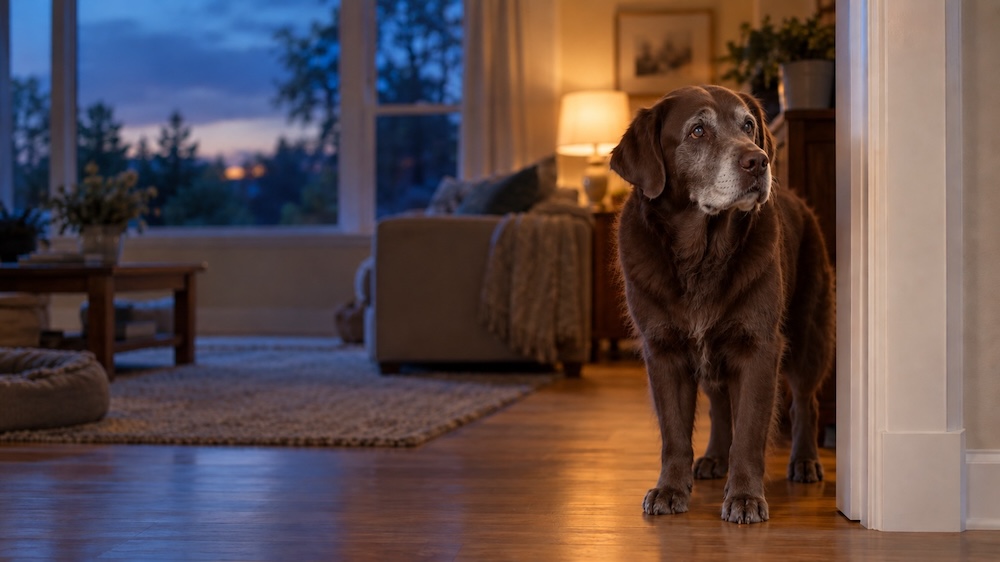
Cognitive dysfunction is a diagnosis of exclusion.7 That isn't a formality. Several conditions produce night-time restlessness in an old dog and every one of them is treated differently.
Before I'd settle on dementia, I want to have ruled out:12
So the workup is a physical and neurological exam, bloodwork, a thyroid level, urinalysis and blood pressure.1,7 Most of that is one visit and one blood draw. Imaging is for the cases that don't fit.
Plenty of dogs have both. An arthritic thirteen-year-old with early cognitive change is the normal patient, not the exception, and treating the pain often buys back a good part of the night on its own.
DISHAA is the framework vets use to screen for cognitive dysfunction, and it's the structure behind the questions I'll ask you.1,7 Six categories: Disorientation, Interactions, Sleep-wake cycle, House-soiling, Activity, and Anxiety.
Run through it before your appointment. Owners consistently underestimate this. In one survey, 75% of dogs had at least one behaviour change pointing to cognitive dysfunction, and only 12% of owners had mentioned it to their vet.1
| Category | What you'd notice early | How it shows up at night |
|---|---|---|
| Disorientation | Hesitating at the top of familiar stairs, standing at the hinge side of a door | Getting stuck in corners, staring at walls, wandering room to room |
| Interactions | Less interest in greeting you, or newly clingy | Following you from room to room, or not settling unless touching you |
| Sleep-wake cycle | Napping more in the afternoon | Awake and active from 2am, sleeping it off all morning |
| House-soiling | The occasional accident after a long stretch of being clean | Urinating indoors soon after coming in from the yard |
| Activity | Less play, shorter walks, more staring | Repetitive pacing and circling with no destination |
| Anxiety | New noise sensitivity, worse separation distress | Panting, whining, barking at nothing |
Two numbers to hold in mind while you read that. Of dogs aged eleven to twelve, 28% showed impairment in at least one category, and by fifteen to sixteen that figure was 68%.2 Some degree of this is close to normal aging. Whether it needs treating depends on how much it's costing the dog and the household.
Start here rather than with a prescription. The environmental work is what the drugs are layered onto, and in mild cases it's enough on its own.
Give this three to four weeks before you judge it. Then write down what changed, because that's the baseline we'll measure the next step against.
None of these are quick fixes and I'd be cautious of anyone who tells you otherwise. Most take weeks to declare themselves, and it's normal to end up using two or three things that work differently toward the same goal.
| Option | What it's for | Time to know | Watch-outs |
|---|---|---|---|
| Selegiline (Anipryl) | The cognitive decline itself. The only drug ever approved for CCD in dogs | 4 to 12 weeks1,8 | Cannot be combined with SSRIs, tricyclics, trazodone or tramadol8,9 |
| Melatonin | Resetting a reversed sleep-wake cycle | Days to 2 weeks | Never use human gummies. See below |
| Trazodone or gabapentin | Night-time agitation and anxiety, not the dementia | Same night to a few days | Sedation. Gabapentin also helps arthritis pain |
| Fluoxetine or clomipramine | Persistent anxiety running through the whole day | 4 to 6 weeks | Long washout needed before or after selegiline9 |
| MCT or antioxidant diet | Slowing the decline. Purina NeuroCare, Hill's b/d | 8 weeks to 8 months1,8 | A fussy senior may refuse the switch |
| SAMe, Senilife, omega-3 | Adjunct support alongside the above | 4 to 8 weeks8 | Product quality varies. Ask before buying online |
Selegiline is the one drug aimed at the condition rather than the symptoms. In the manufacturer's field trial of 404 dogs, roughly 60% were rated improved after one month and about 77% by two months, with around 20% not responding at all.9 Dosing is 0.5 to 1.0 mg/kg once daily in the morning.8,9 Availability is a conversation to have at the appointment.
The interaction in that table is the one I'd underline. Selegiline is a monoamine oxidase inhibitor, and combining it with an SSRI or a tricyclic has been linked to severe central nervous system toxicity, including death. The label calls for at least 14 days between the two, and at least five weeks after fluoxetine because it stays in the system so long.9 Trazodone and tramadol are on the same list.8 If your dog is already on something for anxiety, that shapes the whole plan, so tell us everything before we start.
On melatonin, buy the dose from us rather than the drugstore. Human melatonin gummies routinely contain xylitol, which triggers a rapid insulin release in dogs and causes dangerous drops in blood sugar, and in some dogs liver injury.10 Strength is unreliable too. When researchers tested 25 melatonin gummy products sold in the US, 22 were inaccurately labelled and the actual content ran from 74% to 347% of what the box claimed.11 That's not a product I'd hand a fifteen-year-old dog.
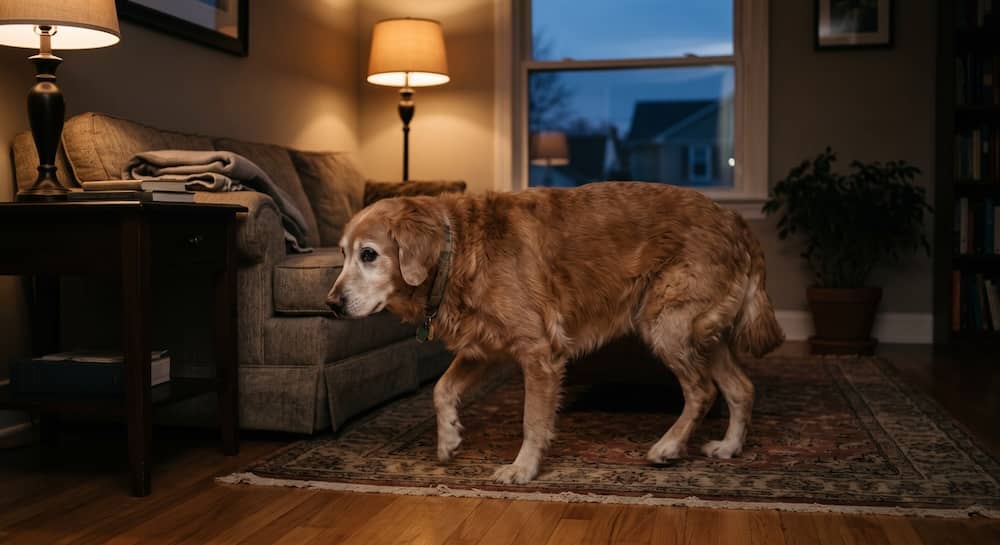
It's a progressive condition and the honest answer is that it moves at a different pace in every dog.
A Danish group followed a group of senior dogs for two years. A third of the dogs who started with normal cognition had slipped into mild impairment, and 22% of the mildly impaired dogs had progressed to full cognitive dysfunction. None of the dogs who already had CCD went backwards.6
In a separate long-term study, dogs with CCD reached a median age of 13.9 years, slightly older than the dogs without it, and the authors concluded that these dogs have a good chance of living a full lifespan if they're supported.5 That's worth holding onto at 3am.
It does ask something of you every single night, though. So at each recheck I want to know how the household is coping as well as how the dog is doing, because that's usually what decides how this ends.
When the nights stop being manageable despite everything, that's a conversation to have out loud with your vet rather than alone at 4am. We talk about quality of life openly and there's no wrong time to raise it.
If the changes came on gradually over months, book a senior exam with bloodwork and a urine sample. Ruling out pain, kidney disease and thyroid disease is the first job, and it's often where the answer is.
If they came on this week, don't wait for that appointment. Sudden disorientation in an old dog is a different problem.
Before you come in, spend a week keeping a note by the bed. What time the dog gets up, what they do, how long it takes to settle, and what you tried. Bring the DISHAA list with the categories that fit marked off. That record tells me more than the exam will, because the dog who paces your hallway at 3am is not the dog standing on my table at 2pm.
Start the daytime activity and the fixed routine now. It costs nothing, it's the piece with the strongest evidence behind it, and it works better started early than late.
You can book online or call us at (519) 896-0532.
Several things land at the same time. The body clock drifts, which is one of the six core categories of cognitive dysfunction, so a dog who has napped all day arrives at bedtime with no sleep pressure left. The light goes, and a dog navigating on habit and failing vision stops coping in a dark hallway. The house goes quiet, so there's nothing left to anchor to. And arthritis gets louder once a dog lies down and stiffens up. It's rarely one cause, which is why the fix is usually several small changes rather than one pill.
Sundowners isn't a separate condition. It's the evening pattern of canine cognitive dysfunction, which is the closest thing dogs have to Alzheimer's disease. Same brain changes, same six categories of signs. Sundowning is just the name for the fact that it gets worse as the light goes. Your vet will diagnose and treat the cognitive dysfunction underneath it.
Most dogs are over eight, and the risk climbs steeply from there. In a study of 15,019 dogs, the odds of cognitive dysfunction rose 52% with each additional year of age. Of dogs aged eleven to twelve, 28% showed impairment in at least one behavioural category, and by fifteen to sixteen that figure was 68%. If your dog is under seven and doing this, I'd be looking hard for another cause first.
Longer than most owners expect. In a Danish study that followed affected dogs long term, the dogs with cognitive dysfunction reached a median age of 13.9 years, which was slightly older than the dogs without it, and the authors concluded these dogs have a good chance of living a full lifespan if they're supported. The condition does progress, and it asks something of you every night, but the diagnosis on its own doesn't mean your dog is near the end.
Only the dose and product your vet gives you. Human melatonin gummies frequently contain xylitol, which causes a rapid insulin release in dogs, dangerous drops in blood sugar and in some dogs liver injury. Strength is unreliable too. When researchers tested 25 melatonin gummy products sold in the US, 22 were inaccurately labelled and the real content ran anywhere from 74% to 347% of what the box said. Melatonin can genuinely help reset a reversed sleep cycle. Just don't source it from the drugstore aisle.
Often both, and pain is the most common thing mistaken for dementia. A dog who can't get comfortable is restless, and restlessness at night looks exactly like sundowning. That's why cognitive dysfunction is a diagnosis of exclusion, and why the first appointment is an exam, bloodwork, a urine sample and a blood pressure rather than a prescription. In an arthritic thirteen-year-old, treating the pain often buys back a good part of the night on its own.
No, and that's the useful part of the question. Cognitive dysfunction develops over months. A dog who was completely normal this morning and is disoriented, circling, head pressing or falling tonight has a different problem, and vestibular disease, a brain event, low blood sugar and toxins are all on that list. That dog needs to be seen the same day rather than managed at home.
Yes, and it's one of the cheapest things you can try. Light the route from the bed to the door and to the water bowl. A dog running on habit and poor night vision needs the landmarks visible. Pair it with dimming the rest of the house early and cutting evening stimulation, which is the standard advice for night waking, and give the whole package three to four weeks before you decide whether it worked.
Sources


